6HAP | pdb_00006hap

Adenylate kinase


Experimental Data Snapshot

  • Method: X-RAY DIFFRACTION
  • Resolution: 2.70 Å
  • R-Value Free: 
    0.278 (Depositor), 0.278 (DCC) 
  • R-Value Work: 
    0.224 (Depositor), 0.227 (DCC) 
  • R-Value Observed: 
    0.226 (Depositor) 

Starting Model: experimental
View more details

wwPDB Validation 3D Report Full Report

Validation slider image for 6HAP

Ligand Structure Quality Assessment 


This is version 1.1 of the entry. See complete history

Literature

Manipulating the Folding Landscape of a Multidomain Protein.

Kantaev, R.Riven, I.Goldenzweig, A.Barak, Y.Dym, O.Peleg, Y.Albeck, S.Fleishman, S.J.Haran, G.

(2018) J Phys Chem B 122: 11030-11038

  • DOI: https://doi.org/10.1021/acs.jpcb.8b04834
  • Primary Citation Related Structures: 
    6HAM, 6HAP

  • PubMed Abstract: 

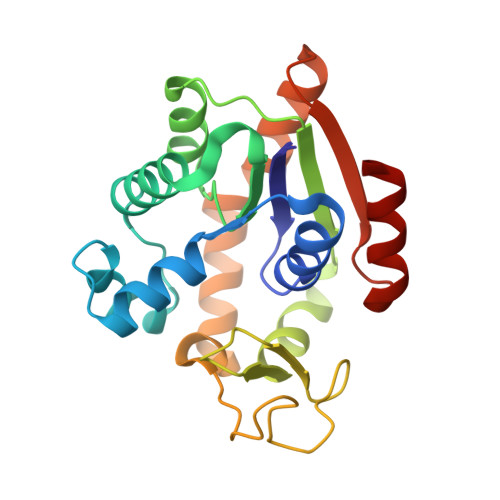
    Folding of proteins to their functional conformation is paramount to life. Though 75% of the proteome consists of multidomain proteins, our knowledge of folding has been based primarily on studies conducted on single-domain and fast-folding proteins. Nonetheless, the complexity of folding landscapes exhibited by multidomain proteins has received increased scrutiny in recent years. We study the three-domain protein adenylate kinase from E. coli (AK), which has been shown to fold through a series of pathways involving several intermediate states. We use a protein design method to manipulate the folding landscape of AK, and single-molecule FRET spectroscopy to study the effects on the folding process. Mutations introduced in the NMP binding (NMPbind) domain of the protein are found to have unexpected effects on the folding landscape. Thus, while stabilizing mutations in the core of the NMPbind domain retain the main folding pathways of wild-type AK, a destabilizing mutation at the interface between the NMPbind and the CORE domains causes a significant repartition of the flux between the folding pathways. Our results demonstrate the outstanding plasticity of the folding landscape of AK and reveal how specific mutations in the primary structure are translated into changes in folding dynamics. The combination of methodologies introduced in this work should prove useful for deepening our understanding of the folding process of multidomain proteins.

Macromolecule Content 

  • Total Structure Weight: 24.61 kDa 
  • Atom Count: 1,684 
  • Modeled Residue Count: 214 
  • Deposited Residue Count: 214 
  • Unique protein chains: 1

Macromolecules

Find similar proteins by:|  3D Structure
Entity ID: 1
MoleculeChains  Sequence LengthOrganismDetailsImage
Adenylate kinase214Escherichia coli O139:H28 str. E24377AMutation(s): 0 
Gene Names: adkEcE24377A_0513
EC: 2.7.4.3
UniProt
Find proteins for P69441 (Escherichia coli (strain K12))
Explore P69441 
Go to UniProtKB:  P69441
Entity Groups
Sequence Clusters30% Identity50% Identity70% Identity90% Identity95% Identity100% Identity
UniProt GroupP69441
Sequence Annotations
Expand
Reference Sequence

Small Molecules

Ligands 1 Unique
IDChains Name / Formula / InChI Key2D Diagram3D Interactions
AP5

Query on AP5


Download:Ideal Coordinates CCD File
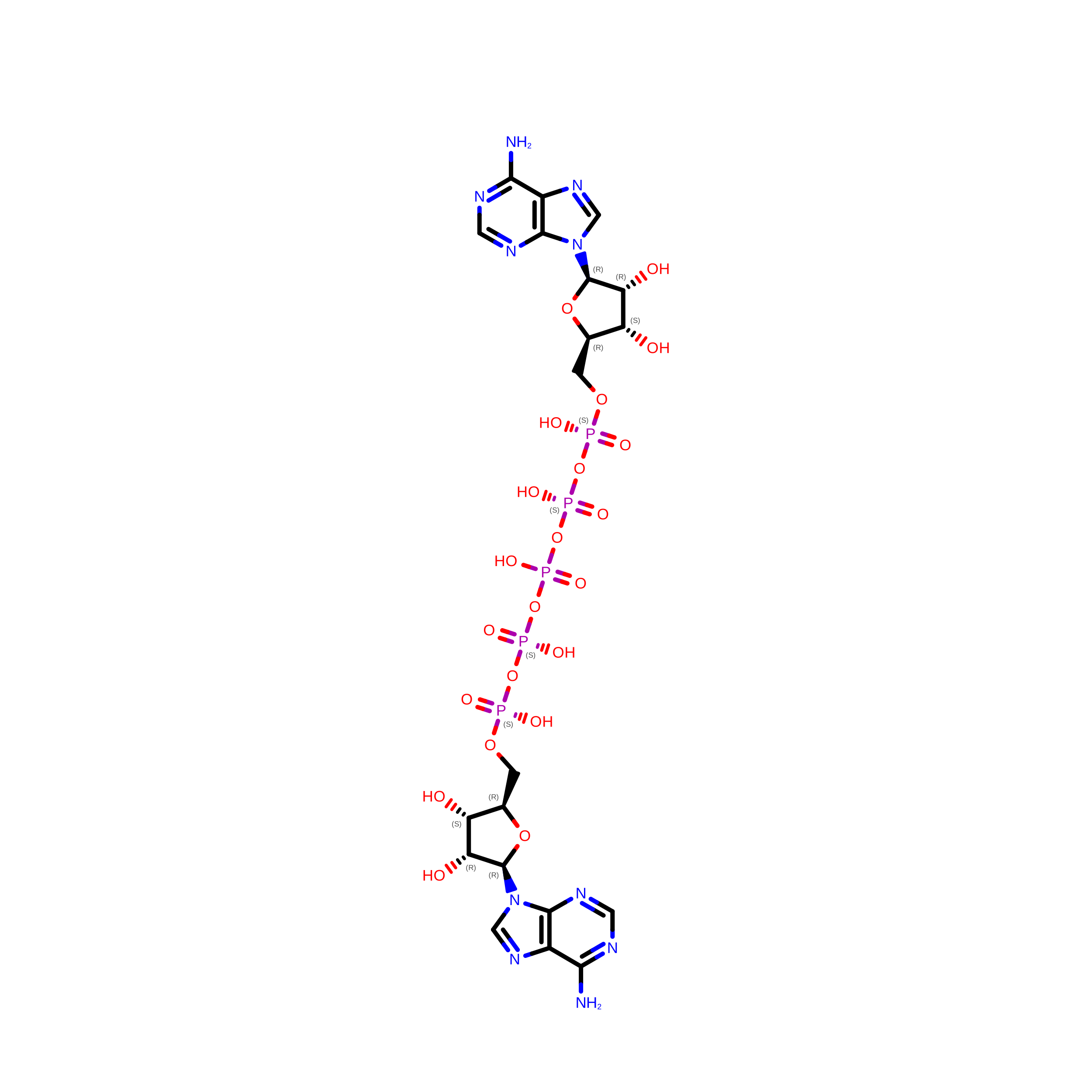
B [auth A]BIS(ADENOSINE)-5'-PENTAPHOSPHATE
C20 H29 N10 O22 P5
OIMACDRJUANHTJ-XPWFQUROSA-N

Experimental Data & Validation

Experimental Data

  • Method: X-RAY DIFFRACTION
  • Resolution: 2.70 Å
  • R-Value Free:  0.278 (Depositor), 0.278 (DCC) 
  • R-Value Work:  0.224 (Depositor), 0.227 (DCC) 
  • R-Value Observed: 0.226 (Depositor) 
Space Group: I 2 2 2
Unit Cell:
Length ( Å )Angle ( ˚ )
a = 73.56α = 90
b = 76.84β = 90
c = 86.98γ = 90
Software Package:
Software NamePurpose
PHENIXrefinement
iMOSFLMdata reduction
SCALEPACKdata scaling
PHASERphasing

Structure Validation

View Full Validation Report


Ligand Structure Quality Assessment 


Entry History 

Deposition Data

Revision History  (Full details and data files)

  • Version 1.0: 2019-08-28
    Type: Initial release
  • Version 1.1: 2024-01-17
    Changes: Data collection, Database references, Refinement description