6KBW | pdb_00006kbw

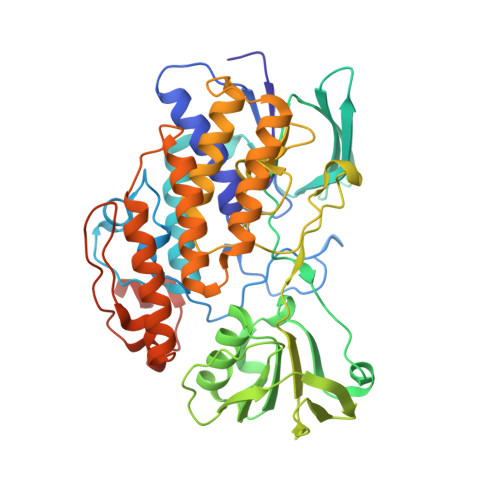
Crystal structure of Tmm from Myroides profundi D25


Experimental Data Snapshot

  • Method: X-RAY DIFFRACTION
  • Resolution: 1.69 Å
  • R-Value Free: 
    0.206 (Depositor), 0.204 (DCC) 
  • R-Value Work: 
    0.177 (Depositor), 0.178 (DCC) 
  • R-Value Observed: 
    0.179 (Depositor) 

Starting Model: experimental
View more details

wwPDB Validation 3D Report Full Report

Validation slider image for 6KBW

Ligand Structure Quality Assessment 


This is version 1.2 of the entry. See complete history

Literature

Oxidation of trimethylamine to trimethylamine N-oxide facilitates high hydrostatic pressure tolerance in a generalist bacterial lineage.

Qin, Q.L.Wang, Z.B.Su, H.N.Chen, X.L.Miao, J.Wang, X.J.Li, C.Y.Zhang, X.Y.Li, P.Y.Wang, M.Fang, J.Lidbury, I.Zhang, W.Zhang, X.H.Yang, G.P.Chen, Y.Zhang, Y.Z.

(2021) Sci Adv 7

  • DOI: https://doi.org/10.1126/sciadv.abf9941
  • Primary Citation Related Structures: 
    6KBW

  • PubMed Abstract: 

    High hydrostatic pressure (HHP) is a characteristic environmental factor of the deep ocean. However, it remains unclear how piezotolerant bacteria adapt to HHP. Here, we identify a two-step metabolic pathway to cope with HHP stress in a piezotolerant bacterium. Myroides profundi D25 T , obtained from a deep-sea sediment, can take up trimethylamine (TMA) through a previously unidentified TMA transporter, TmaT, and oxidize intracellular TMA into trimethylamine N -oxide (TMAO) by a TMA monooxygenase, Mp Tmm. The produced TMAO is accumulated in the cell, functioning as a piezolyte, improving both growth and survival at HHP. The function of the TmaT- Mp Tmm pathway was further confirmed by introducing it into Escherichia coli and Bacillus subtilis Encoded TmaT-like and Mp Tmm-like sequences extensively exist in marine metagenomes, and other marine Bacteroidetes bacteria containing genes encoding TmaT-like and Mp Tmm-like proteins also have improved HHP tolerance in the presence of TMA, implying the universality of this HHP tolerance strategy in marine Bacteroidetes.


  • Organizational Affiliation
    • State Key Laboratory of Microbial Technology, Shandong University, Qingdao, China.

Macromolecule Content 

  • Total Structure Weight: 112.92 kDa 
  • Atom Count: 8,422 
  • Modeled Residue Count: 892 
  • Deposited Residue Count: 934 
  • Unique protein chains: 1

Macromolecules

Find similar proteins by:|  3D Structure
Entity ID: 1
MoleculeChains  Sequence LengthOrganismDetailsImage
Trimethylamine monooxygenase
A, B
467Myroides profundiMutation(s): 0 
Gene Names: MPR_3295
EC: 1.14.13.148
UniProt
Find proteins for A0A0B5RNJ4 (Myroides profundi)
Explore A0A0B5RNJ4 
Go to UniProtKB:  A0A0B5RNJ4
Entity Groups
Sequence Clusters30% Identity50% Identity70% Identity90% Identity95% Identity100% Identity
UniProt GroupA0A0B5RNJ4
Sequence Annotations
Expand
Reference Sequence

Experimental Data & Validation

Experimental Data

  • Method: X-RAY DIFFRACTION
  • Resolution: 1.69 Å
  • R-Value Free:  0.206 (Depositor), 0.204 (DCC) 
  • R-Value Work:  0.177 (Depositor), 0.178 (DCC) 
  • R-Value Observed: 0.179 (Depositor) 
Space Group: P 21 21 21
Unit Cell:
Length ( Å )Angle ( ˚ )
a = 75.543α = 90
b = 99.372β = 90
c = 144.925γ = 90
Software Package:
Software NamePurpose
PHENIXrefinement
HKL-2000data collection
HKL-2000data scaling
PHENIXmodel building
PHENIXphasing

Structure Validation

View Full Validation Report


Ligand Structure Quality Assessment 


Entry History 

Deposition Data

Revision History  (Full details and data files)

  • Version 1.0: 2020-07-08
    Type: Initial release
  • Version 1.1: 2022-01-19
    Changes: Database references
  • Version 1.2: 2023-11-22
    Changes: Data collection, Refinement description