Download Mendeley
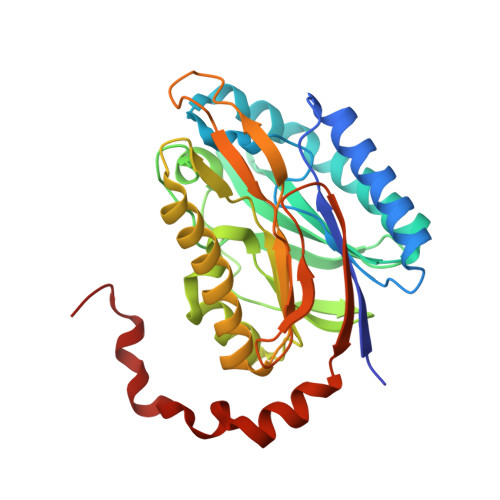
Crystal structure of carbon-nitrogen hydrolase from Helicobacter pylori G27.
Srivastava, A., Ayanlade, J.P., Suleiman, L., Udell, H., Abendroth, J., Lorimer, D.J., Edwards, T.E., Staker, B.L., Zigweid, R., Subramanian, S., Myler, P.J., Chakafana, G., Asojo, O.A.(2026) Acta Crystallogr F Struct Biol Commun
- PubMed: 41705774
- DOI: https://doi.org/10.1107/S2053230X26001330
- Primary Citation of Related Structures:
6MG6 - PubMed Abstract:
Carbon-nitrogen hydrolases (CNHs) are members of the diverse nitrilase superfamily of enzymes that facilitate cellular adaptation to environmental stress by metabolizing nitrogen, detoxifying xenobiotics and catabolizing environmentally derived metabolites. Helicobacter pylori CNH (HpCNH) may contribute to metabolic flexibility under acid stress, detoxification of reactive nitrogen species or nutrient scavenging in the nutrient-limited gastric environment. Here, we report the 2.1 Å resolution crystal structure of a CNH from H. pylori strain G27 (PDB entry 6mg6). HpCNH adopts the characteristic nitrilase-superfamily αββα-sandwich core and contains the conserved catalytic cysteine typical of enzymatically active CNHs. The overall structure and active site of HpCNH are most similar to those of carbamoylputrescine amidohydrolase from the plant Medicago truncatula. Despite structural variations in loop regions, including near the active site, HpCNH retains the key residues required to bind putrescine and the prototypical N-carbamoylputrescine amidase active site.
- California Institute of Technology, 1200 East California Boulevard, Pasadena, CA 91125, USA.
Organizational Affiliation: