6N6E | pdb_00006n6e

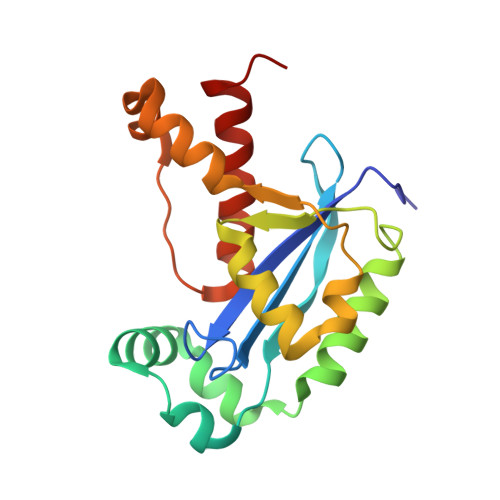
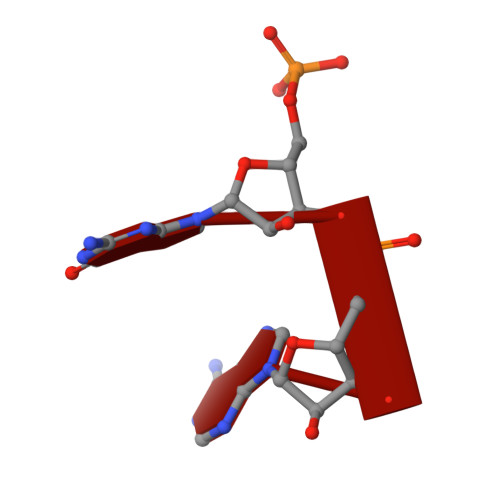
Vibrio cholerae Oligoribonuclease bound to pGA


Experimental Data Snapshot

  • Method: X-RAY DIFFRACTION
  • Resolution: 1.58 Å
  • R-Value Free: 
    0.159 (Depositor), 0.161 (DCC) 
  • R-Value Work: 
    0.152 (Depositor), 0.154 (DCC) 
  • R-Value Observed: 
    0.152 (Depositor) 

Starting Model: experimental
View more details

wwPDB Validation 3D Report Full Report

Validation slider image for 6N6E

This is version 1.3 of the entry. See complete history

Literature

A dedicated diribonucleotidase resolves a key bottleneck for the terminal step of RNA degradation.

Kim, S.K.Lormand, J.D.Weiss, C.A.Eger, K.A.Turdiev, H.Turdiev, A.Winkler, W.C.Sondermann, H.Lee, V.T.

(2019) Elife 8

  • DOI: https://doi.org/10.7554/eLife.46313
  • Primary Citation Related Structures: 
    6N6A, 6N6C, 6N6D, 6N6E, 6N6F, 6N6G, 6N6H, 6N6I, 6N6J, 6N6K

  • PubMed Abstract: 

    Degradation of RNA polymers, an ubiquitous process in all cells, is catalyzed by specific subsets of endo- and exoribonucleases that together recycle RNA fragments into nucleotide monophosphate. In γ-proteobacteria, 3-'5' exoribonucleases comprise up to eight distinct enzymes. Among them, Oligoribonuclease (Orn) is unique as its activity is required for clearing short RNA fragments, which is important for cellular fitness. However, the molecular basis of Orn's unique cellular function remained unclear. Here, we show that Orn exhibits exquisite substrate preference for diribonucleotides. Crystal structures of substrate-bound Orn reveal an active site optimized for diribonucleotides. While other cellular RNases process oligoribonucleotides down to diribonucleotide entities, Orn is the one and only diribonucleotidase that completes the terminal step of RNA degradation. Together, our studies indicate RNA degradation as a step-wise process with a dedicated enzyme for the clearance of a specific intermediate pool, diribonucleotides, that affects cellular physiology and viability.


  • Organizational Affiliation
    • Department of Cell Biology and Molecular Genetics, University of Maryland, College Park, United States.

Macromolecule Content 

  • Total Structure Weight: 21.61 kDa 
  • Atom Count: 1,819 
  • Modeled Residue Count: 183 
  • Deposited Residue Count: 183 
  • Unique protein chains: 1
  • Unique nucleic acid chains: 1

Macromolecules


Find similar proteins by:|  3D Structure
Entity ID: 1
MoleculeChains  Sequence LengthOrganismDetailsImage
RNA exonuclease 2 homolog,Small fragment nuclease181Vibrio choleraeMutation(s): 0 
Gene Names: orn
EC: 3.1 (PDB Primary Data), 3.1.15 (UniProt)
UniProt
Find proteins for Q9KV17 (Vibrio cholerae serotype O1 (strain ATCC 39315 / El Tor Inaba N16961))
Explore Q9KV17 
Go to UniProtKB:  Q9KV17
Entity Groups
Sequence Clusters30% Identity50% Identity70% Identity90% Identity95% Identity100% Identity
UniProt GroupQ9KV17
Sequence Annotations
Expand
Reference Sequence
Find similar nucleic acids by:  Sequence
Entity ID: 2
MoleculeChains LengthOrganismImage
RNA (5'-R(P*GP*A)-3')B [auth D]2synthetic construct
Sequence Annotations
Expand
Reference Sequence

Small Molecules

Ligands 1 Unique
IDChains Name / Formula / InChI Key2D Diagram3D Interactions
NA

Query on NA


Download:Ideal Coordinates CCD File
C [auth D]SODIUM ION
Na
FKNQFGJONOIPTF-UHFFFAOYSA-N

Experimental Data & Validation

Experimental Data

  • Method: X-RAY DIFFRACTION
  • Resolution: 1.58 Å
  • R-Value Free:  0.159 (Depositor), 0.161 (DCC) 
  • R-Value Work:  0.152 (Depositor), 0.154 (DCC) 
  • R-Value Observed: 0.152 (Depositor) 
Space Group: P 32 2 1
Unit Cell:
Length ( Å )Angle ( ˚ )
a = 89.615α = 90
b = 89.615β = 90
c = 59.683γ = 120
Software Package:
Software NamePurpose
XDSdata reduction
SCALAdata scaling
PHENIXrefinement
PDB_EXTRACTdata extraction
PHENIXphasing

Structure Validation

View Full Validation Report


Entry History 

& Funding Information

Deposition Data


Funding OrganizationLocationGrant Number
National Institutes of Health/National Institute of General Medical Sciences (NIH/NIGMS)United StatesR01GM123609

Revision History  (Full details and data files)

  • Version 1.0: 2019-06-12
    Type: Initial release
  • Version 1.1: 2019-10-16
    Changes: Data collection, Database references
  • Version 1.2: 2020-01-01
    Changes: Author supporting evidence
  • Version 1.3: 2023-10-11
    Changes: Data collection, Database references, Derived calculations, Refinement description