Download Mendeley
Cryo-EM structure of human type-3 inositol triphosphate receptor reveals the presence of a self-binding peptide that acts as an antagonist.
Azumaya, C.M., Linton, E.A., Risener, C.J., Nakagawa, T., Karakas, E.(2020) J Biol Chem 295: 1743-1753
- PubMed: 31915246 Search on PubMedSearch on PubMed Central
- DOI: https://doi.org/10.1074/jbc.RA119.011570
- Primary Citation Related Structures:
6UQK - PubMed Abstract:
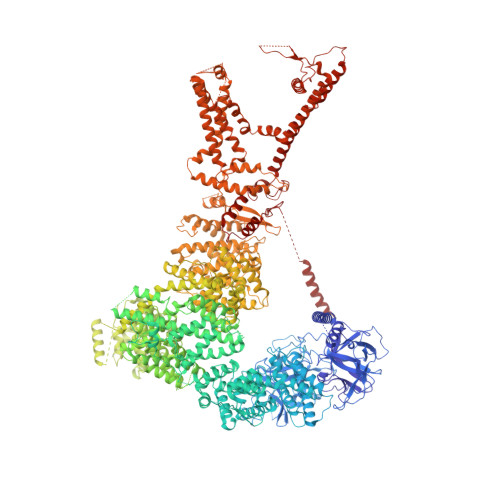
Calcium-mediated signaling through inositol 1,4,5-triphosphate receptors (IP 3 Rs) is essential for the regulation of numerous physiological processes, including fertilization, muscle contraction, apoptosis, secretion, and synaptic plasticity. Deregulation of IP 3 Rs leads to pathological calcium signaling and is implicated in many common diseases, including cancer and neurodegenerative, autoimmune, and metabolic diseases. Revealing the mechanism of activation and inhibition of this ion channel will be critical to an improved understanding of the biological processes that are controlled by IP 3 Rs. Here, we report structural findings of the human type-3 IP 3 R (IP 3 R-3) obtained by cryo-EM (at an overall resolution of 3.8 Å), revealing an unanticipated regulatory mechanism where a loop distantly located in the primary sequence occupies the IP 3 -binding site and competitively inhibits IP 3 binding. We propose that this inhibitory mechanism must differ qualitatively among IP 3 R subtypes because of their diverse loop sequences, potentially serving as a key molecular determinant of subtype-specific calcium signaling in IP 3 Rs. In summary, our structural characterization of human IP 3 R-3 provides critical insights into the mechanistic function of IP 3 Rs and into subtype-specific regulation of these important calcium-regulatory channels.
- Department of Molecular Physiology and Biophysics, Vanderbilt University, School of Medicine, Nashville, Tennessee 37232.
Organizational Affiliation: