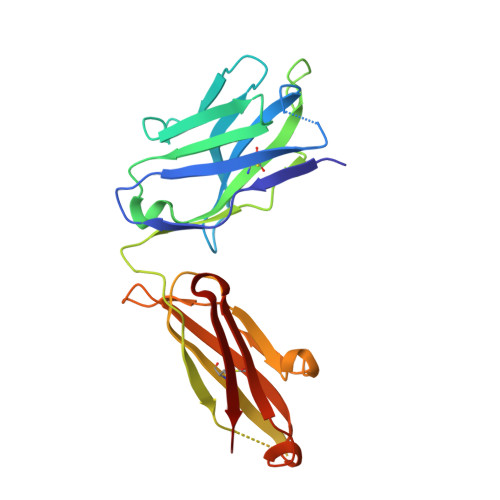
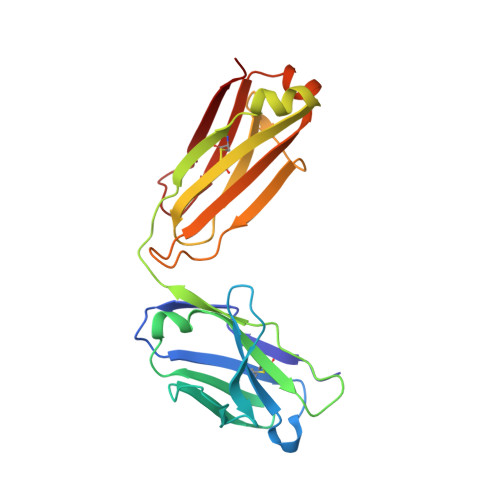
6YXL | pdb_00006yxl

Crystal structure of ACPA F3

  • Classification: IMMUNE SYSTEM
  • Organism(s): Homo sapiens
  • Expression System: Homo sapiens
  • Mutation(s): No 

  • Deposited: 2020-05-03 Released: 2021-05-12 
  • Deposition Author(s): Ge, C., Holmdahl, R.
  • Funding Organization(s): Swedish Research Council, Knut and Alice Wallenberg Foundation

Experimental Data Snapshot

  • Method: X-RAY DIFFRACTION
  • Resolution: 2.10 Å
  • R-Value Free: 
    0.231 (Depositor), 0.231 (DCC) 
  • R-Value Work: 
    0.199 (Depositor), 0.199 (DCC) 

Starting Model: experimental
View more details

wwPDB Validation 3D Report Full Report

Validation slider image for 6YXL

This is version 1.3 of the entry. See complete history

Literature

Surface Ig variable domain glycosylation affects autoantigen binding and acts as threshold for human autoreactive B cell activation.

Kissel, T.Ge, C.Hafkenscheid, L.Kwekkeboom, J.C.Slot, L.M.Cavallari, M.He, Y.van Schie, K.A.Vergroesen, R.D.Kampstra, A.S.B.Reijm, S.Stoeken-Rijsbergen, G.Koeleman, C.Voortman, L.M.Heitman, L.H.Xu, B.Pruijn, G.J.M.Wuhrer, M.Rispens, T.Huizinga, T.W.J.Scherer, H.U.Reth, M.Holmdahl, R.Toes, R.E.M.

(2022) Sci Adv 8: eabm1759-eabm1759

  • DOI: https://doi.org/10.1126/sciadv.abm1759
  • Primary Citation Related Structures: 
    6YXK, 6YXL, 6YXM

  • PubMed Abstract: 

    The hallmark autoantibodies in rheumatoid arthritis are characterized by variable domain glycans (VDGs). Their abundant occurrence results from the selective introduction of N-linked glycosylation sites during somatic hypermutation, and their presence is predictive for disease development. However, the functional consequences of VDGs on autoreactive B cells remain elusive. Combining crystallography, glycobiology, and functional B cell assays allowed us to dissect key characteristics of VDGs on human B cell biology. Crystal structures showed that VDGs are positioned in the vicinity of the antigen-binding pocket, and dynamic modeling combined with binding assays elucidated their impact on binding. We found that VDG-expressing B cell receptors stay longer on the B cell surface and that VDGs enhance B cell activation. These results provide a rationale on how the acquisition of VDGs might contribute to the breach of tolerance of autoreactive B cells in a major human autoimmune disease.


  • Organizational Affiliation
    • Department of Rheumatology, Leiden University Medical Center, Leiden, Netherlands.

Macromolecule Content 

  • Total Structure Weight: 47.2 kDa 
  • Atom Count: 3,462 
  • Modeled Residue Count: 427 
  • Deposited Residue Count: 434 
  • Unique protein chains: 2

Macromolecules

Find similar proteins by:|  3D Structure
Entity ID: 1
MoleculeChains  Sequence LengthOrganismDetailsImage
ACPA F3 Fab fragment - heavy chainA [auth HHH]221Homo sapiensMutation(s): 0 
Find similar proteins by:|  3D Structure
Entity ID: 2
MoleculeChains  Sequence LengthOrganismDetailsImage
ACPA F3 Fab fragment - light chainB [auth LLL]213Homo sapiensMutation(s): 0 

Experimental Data & Validation

Experimental Data

  • Method: X-RAY DIFFRACTION
  • Resolution: 2.10 Å
  • R-Value Free:  0.231 (Depositor), 0.231 (DCC) 
  • R-Value Work:  0.199 (Depositor), 0.199 (DCC) 
Space Group: P 41 21 2
Unit Cell:
Length ( Å )Angle ( ˚ )
a = 130.886α = 90
b = 130.886β = 90
c = 61.026γ = 90
Software Package:
Software NamePurpose
REFMACrefinement
REFMACrefinement
Aimlessdata reduction
XDSdata reduction
XDSdata scaling

Structure Validation

View Full Validation Report


Entry History 

& Funding Information

Deposition Data


Funding OrganizationLocationGrant Number
Swedish Research CouncilSweden--
Knut and Alice Wallenberg FoundationSweden--

Revision History  (Full details and data files)

  • Version 1.0: 2021-05-12
    Type: Initial release
  • Version 1.1: 2022-05-25
    Changes: Database references
  • Version 1.2: 2024-01-24
    Changes: Data collection, Derived calculations, Refinement description
  • Version 1.3: 2024-11-06
    Changes: Structure summary