Download Mendeley
Reductive inactivation of the hemiaminal pharmacophore for resistance against tetrahydroisoquinoline antibiotics.
Wen, W.H., Zhang, Y., Zhang, Y.Y., Yu, Q., Jiang, C.C., Tang, M.C., Pu, J.Y., Wu, L., Zhao, Y.L., Shi, T., Zhou, J., Tang, G.L.(2021) Nat Commun 12: 7085-7085
- PubMed: 34873166 Search on PubMedSearch on PubMed Central
- DOI: https://doi.org/10.1038/s41467-021-27404-3
- Primary Citation Related Structures:
7BSX, 7BTM - PubMed Abstract:
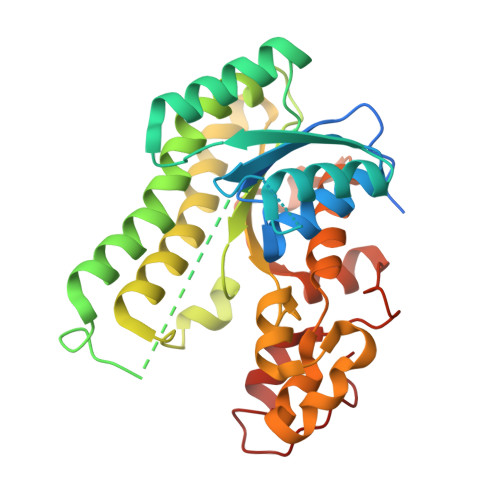
Antibiotic resistance is becoming one of the major crises, among which hydrolysis reaction is widely employed by bacteria to destroy the reactive pharmacophore. Correspondingly, antibiotic producer has canonically co-evolved this approach with the biosynthetic capability for self-resistance. Here we discover a self-defense strategy featuring with reductive inactivation of hemiaminal pharmacophore by short-chain dehydrogenases/reductases (SDRs) NapW and homW, which are integrated with the naphthyridinomycin biosynthetic pathway. We determine the crystal structure of NapW·NADPH complex and propose a catalytic mechanism by molecular dynamics simulation analysis. Additionally, a similar detoxification strategy is identified in the biosynthesis of saframycin A, another member of tetrahydroisoquinoline (THIQ) antibiotics. Remarkably, similar SDRs are widely spread in bacteria and able to inactive other THIQ members including the clinical anticancer drug, ET-743. These findings not only fill in the missing intracellular events of temporal-spatial shielding mode for cryptic self-resistance during THIQs biosynthesis, but also exhibit a sophisticated damage-control in secondary metabolism and general immunity toward this family of antibiotics.
- State Key Laboratory of Bio-organic and Natural Products Chemistry, Center for Excellence in Molecular Synthesis, Shanghai Institute of Organic Chemistry, University of Chinese Academy of Sciences, Chinese Academy of Sciences, 345 Lingling Road, Shanghai, 200032, China.
Organizational Affiliation: