Download Mendeley
From Protein Design to the Energy Landscape of a Cold Unfolding Protein.
Pulavarti, S.V.S.R.K., Maguire, J.B., Yuen, S., Harrison, J.S., Griffin, J., Premkumar, L., Esposito, E.A., Makhatadze, G.I., Garcia, A.E., Weiss, T.M., Snell, E.H., Kuhlman, B., Szyperski, T.(2022) J Phys Chem B 126: 1212-1231
- PubMed: 35128921 Search on PubMedSearch on PubMed Central
- DOI: https://doi.org/10.1021/acs.jpcb.1c10750
- Primary Citation Related Structures:
7T03, 7T2Y - PubMed Abstract:
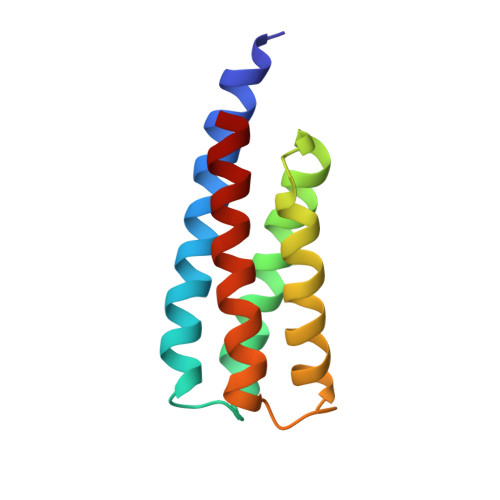
Understanding protein folding is crucial for protein sciences. The conformational spaces and energy landscapes of cold (unfolded) protein states, as well as the associated transitions, are hardly explored. Furthermore, it is not known how structure relates to the cooperativity of cold transitions, if cold and heat unfolded states are thermodynamically similar, and if cold states play important roles for protein function. We created the cold unfolding 4-helix bundle DCUB1 with a de novo designed bipartite hydrophilic/hydrophobic core featuring a hydrogen bond network which extends across the bundle in order to study the relative importance of hydrophobic versus hydrophilic protein-water interactions for cold unfolding. Structural and thermodynamic characterization resulted in the discovery of a complex energy landscape for cold transitions, while the heat unfolded state is a random coil. Below ∼0 °C, the core of DCUB1 disintegrates in a largely cooperative manner, while a near-native helical content is retained. The resulting cold core-unfolded state is compact and features extensive internal dynamics. Below -5 °C, two additional cold transitions are seen, that is, (i) the formation of a water-mediated, compact, and highly dynamic dimer, and (ii) the onset of cold helix unfolding decoupled from cold core unfolding. Our results suggest that cold unfolding is initiated by the intrusion of water into the hydrophilic core network and that cooperativity can be tuned by varying the number of core hydrogen bond networks. Protein design has proven to be invaluable to explore the energy landscapes of cold states and to robustly test related theories.
- Department of Chemistry, University at Buffalo, The State University of New York, Buffalo, New York 14260, United States.
Organizational Affiliation: