8F5V | pdb_00008f5v

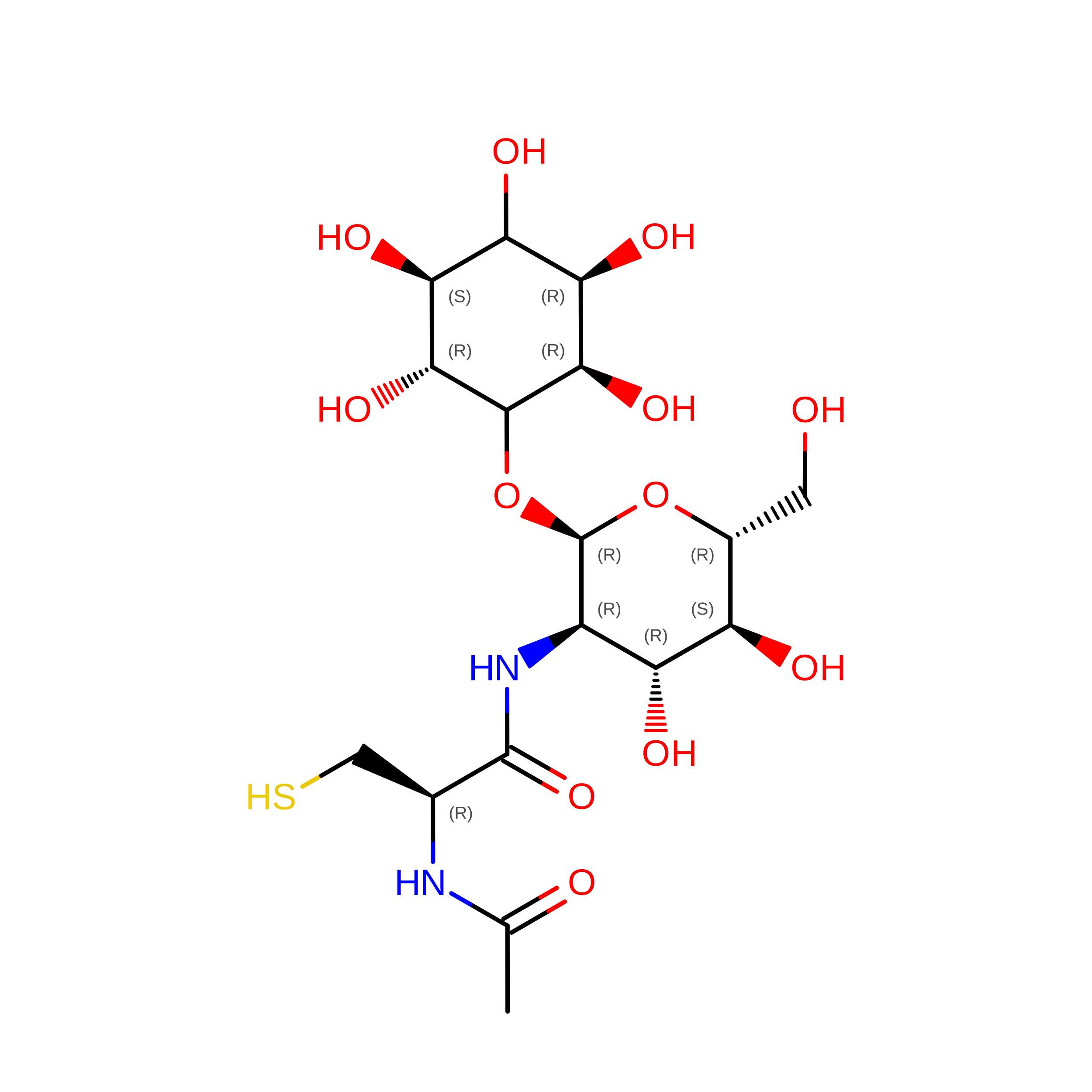
Crystal structure of Mycobacterium tuberculosis Mycothiol S-transferase enzyme in complex with mycothiol and Zn2+


Experimental Data Snapshot

  • Method: X-RAY DIFFRACTION
  • Resolution: 1.45 Å
  • R-Value Free: 
    0.203 (Depositor), 0.204 (DCC) 
  • R-Value Work: 
    0.179 (Depositor), 0.180 (DCC) 
  • R-Value Observed: 
    0.180 (Depositor) 

Starting Model: experimental
View more details

wwPDB Validation 3D Report Full Report

Validation slider image for 8F5V

Ligand Structure Quality Assessment 


This is version 1.1 of the entry. See complete history

Literature

The Mycobacterium tuberculosis mycothiol S -transferase is divalent metal-dependent for mycothiol binding and transfer.

Jayasinghe, Y.P.Banco, M.T.Lindenberger, J.J.Favrot, L.Palcekova, Z.Jackson, M.Manabe, S.Ronning, D.R.

(2023) RSC Med Chem 14: 491-500

  • DOI: https://doi.org/10.1039/d2md00401a
  • Primary Citation Related Structures: 
    8F5V, 8FX9

  • PubMed Abstract: 

    Mycothiol S -transferase (MST) (encoded by the rv0443 gene) was previously identified as the enzyme responsible for the transfer of Mycothiol (MSH) to xenobiotic acceptors in Mycobacterium tuberculosis ( M.tb ) during xenobiotic stress. To further characterize the functionality of MST in vitro and the possible roles in vivo , X-ray crystallographic, metal-dependent enzyme kinetics, thermal denaturation studies, and antibiotic MIC determination in rv0433 knockout strain were performed. The binding of MSH and Zn 2+ increases the melting temperature by 12.9 °C as a consequence of the cooperative stabilization of MST by both MSH and metal. The co-crystal structure of MST in complex with MSH and Zn 2+ to 1.45 Å resolution supports the specific utilization of MSH as a substrate as well as affording insights into the structural requirements of MSH binding and the metal-assisted catalytic mechanism of MST. Contrary to the well-defined role of MSH in mycobacterial xenobiotic responses and the ability of MST to bind MSH, cell-based studies with an M.tb rv0443 knockout strain failed to provide evidence for a role of MST in processing of rifampicin or isoniazid. These studies suggest the necessity of a new direction to identify acceptors of the enzyme and better define the biological role of MST in mycobacteria.


  • Organizational Affiliation
    • Department of Pharmaceutical Sciences, College of Pharmacy, University of Nebraska Medical Center Omaha Nebraska USA don.ronning@unmc.edu.

Macromolecule Content 

  • Total Structure Weight: 38.27 kDa 
  • Atom Count: 3,028 
  • Modeled Residue Count: 334 
  • Deposited Residue Count: 334 
  • Unique protein chains: 1

Macromolecules

Find similar proteins by:|  3D Structure
Entity ID: 1
MoleculeChains  Sequence LengthOrganismDetailsImage
Conserved protein
A, B
167Mycobacterium tuberculosisMutation(s): 0 
Gene Names: Rv0443
UniProt
Find proteins for O53728 (Mycobacterium tuberculosis (strain ATCC 25618 / H37Rv))
Explore O53728 
Go to UniProtKB:  O53728
Entity Groups
Sequence Clusters30% Identity50% Identity70% Identity90% Identity95% Identity100% Identity
UniProt GroupO53728
Sequence Annotations
Expand
Reference Sequence

Experimental Data & Validation

Experimental Data

  • Method: X-RAY DIFFRACTION
  • Resolution: 1.45 Å
  • R-Value Free:  0.203 (Depositor), 0.204 (DCC) 
  • R-Value Work:  0.179 (Depositor), 0.180 (DCC) 
  • R-Value Observed: 0.180 (Depositor) 
Space Group: P 21 21 2
Unit Cell:
Length ( Å )Angle ( ˚ )
a = 75.027α = 90
b = 76.732β = 90
c = 53.261γ = 90
Software Package:
Software NamePurpose
PHENIXrefinement
Aimlessdata scaling
XDSdata reduction
PHENIXphasing

Structure Validation

View Full Validation Report


Ligand Structure Quality Assessment 


Entry History 

& Funding Information

Deposition Data


Funding OrganizationLocationGrant Number
National Institutes of Health/National Institute Of Allergy and Infectious Diseases (NIH/NIAID)United StatesR21AI151924

Revision History  (Full details and data files)

  • Version 1.0: 2023-04-05
    Type: Initial release
  • Version 1.1: 2023-10-11
    Changes: Data collection, Refinement description