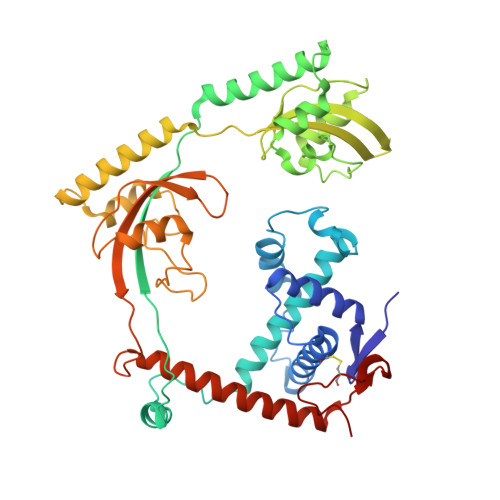
8HM4 | pdb_00008hm4

Crystal structure of PPIase


Experimental Data Snapshot

  • Method: X-RAY DIFFRACTION
  • Resolution: 3.79 Å
  • R-Value Free: 
    0.302 (Depositor), 0.300 (DCC) 
  • R-Value Work: 
    0.284 (Depositor), 0.287 (DCC) 
  • R-Value Observed: 
    0.286 (Depositor) 

Starting Model: in silico
View more details

wwPDB Validation 3D Report Full Report

Validation slider image for 8HM4

This is version 1.3 of the entry. See complete history

Literature

Bacteroides fragilis ubiquitin homologue drives intraspecies bacterial competition in the gut microbiome.

Jiang, K.Li, W.Tong, M.Xu, J.Chen, Z.Yang, Y.Zang, Y.Jiao, X.Liu, C.Lim, B.Jiang, X.Wang, J.Wu, D.Wang, M.Liu, S.J.Shao, F.Gao, X.

(2024) Nat Microbiol 9: 70-84

  • DOI: https://doi.org/10.1038/s41564-023-01541-5
  • Primary Citation Related Structures: 
    8HM1, 8HM2, 8HM3, 8HM4

  • PubMed Abstract: 

    Interbacterial antagonism and associated defensive strategies are both essential during bacterial competition. The human gut symbiont Bacteroides fragilis secretes a ubiquitin homologue (BfUbb) that is toxic to a subset of B. fragilis strains in vitro. In the present study, we demonstrate that BfUbb lyses certain B. fragilis strains by non-covalently binding and inactivating an essential peptidyl-prolyl isomerase (PPIase). BfUbb-sensitivity profiling of B. fragilis strains revealed a key tyrosine residue (Tyr119) in the PPIase and strains that encode a glutamic acid residue at Tyr119 are resistant to BfUbb. Crystal structural analysis and functional studies of BfUbb and the BfUbb-PPIase complex uncover a unique disulfide bond at the carboxy terminus of BfUbb to mediate the interaction with Tyr119 of the PPIase. In vitro coculture assays and mouse studies show that BfUbb confers a competitive advantage for encoding strains and this is further supported by human gut metagenome analyses. Our findings reveal a previously undescribed mechanism of bacterial intraspecies competition.


  • Organizational Affiliation
    • State Key Laboratory of Microbial Technology, Shandong University, Qingdao, China.

Macromolecule Content 

  • Total Structure Weight: 98.54 kDa 
  • Atom Count: 6,807 
  • Modeled Residue Count: 840 
  • Deposited Residue Count: 854 
  • Unique protein chains: 1

Macromolecules

Find similar proteins by:|  3D Structure
Entity ID: 1
MoleculeChains  Sequence LengthOrganismDetailsImage
Peptidylprolyl isomerase
A, B
427Bacteroides fragilisMutation(s): 0 
Gene Names: BN669_00367

Experimental Data & Validation

Experimental Data

  • Method: X-RAY DIFFRACTION
  • Resolution: 3.79 Å
  • R-Value Free:  0.302 (Depositor), 0.300 (DCC) 
  • R-Value Work:  0.284 (Depositor), 0.287 (DCC) 
  • R-Value Observed: 0.286 (Depositor) 
Space Group: P 21 21 21
Unit Cell:
Length ( Å )Angle ( ˚ )
a = 82.425α = 90
b = 126.087β = 90
c = 130.715γ = 90
Software Package:
Software NamePurpose
Blu-Icedata collection
PHENIXrefinement
HKL-3000data reduction
MOLREPphasing
XDSdata processing

Structure Validation

View Full Validation Report


Entry History 

& Funding Information

Deposition Data


Funding OrganizationLocationGrant Number
National Natural Science Foundation of China (NSFC)China32122007

Revision History  (Full details and data files)

  • Version 1.0: 2023-11-29
    Type: Initial release
  • Version 1.1: 2023-12-27
    Changes: Database references
  • Version 1.2: 2024-01-24
    Changes: Database references
  • Version 1.3: 2024-10-30
    Changes: Structure summary