Download Mendeley
Selective peroxynitrite-mediated protein nitration catalyzed by glyoxalase domain containing protein 4.
Wright, S., Dang, V.C., Hussain, S., Kandel, P., Brendza, R.P., Mazhar, S., Whitmore, M., Boudoukha, S., Kaur Banwait, J., Van Der Linden, R., Vertudes, E., Markham, K., Trzeciak, M., Pohan, G., Jennings, A., Shahidi-Latham, S., Kayser, F., Beckstead, M., Lucius, A.L., Kashyap, A., Ischiropoulos, H., Griswold-Prenner, I.(2026) Proc Natl Acad Sci U S A 123: e2515002123-e2515002123
- PubMed: 41628334 Search on PubMedSearch on PubMed Central
- DOI: https://doi.org/10.1073/pnas.2515002123
- Primary Citation Related Structures:
9CSJ - PubMed Abstract:
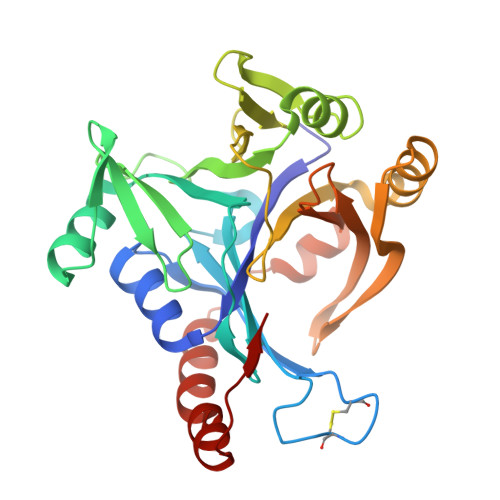
Tyrosine nitration alters the structure, function, and cellular localization of proteins and is implicated in the pathology of multiple diseases [G. Ferrer-Sueta et al. , Chem. Rev. 118 , 1338-1408 (2018), H. Ischiropoulos, Arch. Biochem. Biophys. 356 , 1-11 (1998), I. Griswold-Prenner et al. , J. Biol. Chem. 299 , 105038-10554 (2023)]. Although protein nitration is assumed to proceed via nonspecific chemical mechanisms, it is highly selective, suggesting the possibility of enzymatic catalysis. Here, we showed that glyoxalase domain-containing protein 4 (GLOD4), a previously uncharacterized protein, is an enzyme that catalyzes selective protein nitration. A primary in vivo target for GLOD4-mediated nitration is alpha-synuclein (α-syn), which is central to the pathogenesis of Parkinson's disease (PD) and related disorders. We document tyrosine nitration of α-syn by GLOD4 in vitro, in cells, and in a murine model of synuclein pathology. The data identified a function of GLOD4 and other structurally related proteins that catalyze the peroxynitrite-mediated selective protein tyrosine nitration. This enzymatic catalysis of nitration may unearth pathophysiological mechanisms and potential interventions in diseases such as PD, cancer, and autoimmunity.
- Nitrase Therapeutics, Brisbane, CA 94005.
Organizational Affiliation: