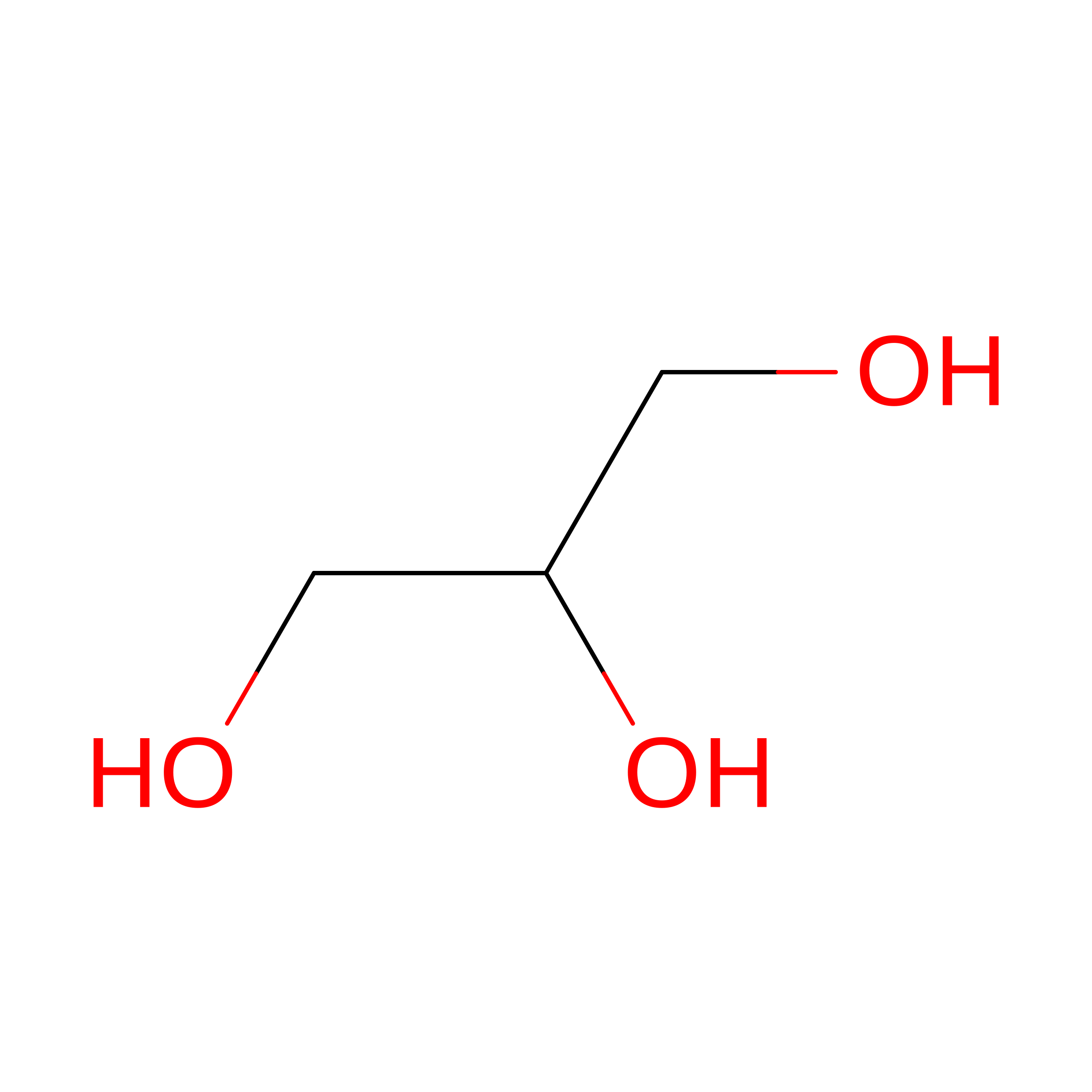
9FD9 | pdb_00009fd9

Re-engineered peroxygenase variant of 2-deoxy-D-ribose-5-phosphate aldolase, Schiff-base complex with 4-nitro-cinnamaldehyde


Experimental Data Snapshot

  • Method: X-RAY DIFFRACTION
  • Resolution: 1.52 Å
  • R-Value Free: 
    0.218 (Depositor), 0.231 (DCC) 
  • R-Value Work: 
    0.186 (Depositor), 0.199 (DCC) 
  • R-Value Observed: 
    0.188 (Depositor) 

Starting Model: experimental
View more details

wwPDB Validation 3D Report Full Report

Validation slider image for 9FD9

Ligand Structure Quality Assessment 


This is version 1.2 of the entry. See complete history

Literature

Engineering 2-Deoxy-D-ribose-5-phosphate Aldolase for anti- and syn-Selective Epoxidations of alpha , beta-Unsaturated Aldehydes.

Zhou, H.Kunzendorf, A.Xu, G.Frietema, H.O.T.Thunnissen, A.W.H.Poelarends, G.J.

(2025) Angew Chem Int Ed Engl 64: e202503054-e202503054

  • DOI: https://doi.org/10.1002/anie.202503054
  • Primary Citation Related Structures: 
    9FD7, 9FD8, 9FD9

  • PubMed Abstract: 

    The enzyme 2-deoxy-D-ribose-5-phosphate aldolase (DERA) naturally catalyzes the reversible aldol addition between acetaldehyde and D-glyceraldehyde-3-phosphate to yield 2-deoxy-D-ribose-5-phosphate. Herein we describe the redesign of DERA into a proficient non-natural peroxygenase that promotes the asymmetric epoxidation of various α,β-unsaturated aldehydes. This repurposed aldolase, named DERA-EP, is able to utilize H 2 O 2 to accomplish both anti- and syn-selective epoxidations of various α,β-unsaturated aldehydes to give the corresponding epoxides with moderate to high diastereoselectivity (diastereomeric ratio up to 99 : 1) and excellent enantioselectivity (enantiomeric ratio up to 99 : 1). Crystallographic analysis of DERA-EP in a substrate-free and substrate-bound state provides a structural context for the evolved activity, a clear explanation for the high enantioselectivity, and compelling evidence for catalysis via enzyme-bound iminium ion intermediates. The unprecedented anti-selectivity of DERA-EP with multiple α,β-unsaturated aldehydes is complementary to the syn-selectivity of previously reported enzyme-, metal- and organo-catalysts, making DERA-EP an attractive new asset to the toolbox of epoxidation catalysts.


  • Organizational Affiliation
    • Department of Chemical and Pharmaceutical Biology, Groningen Research Institute of Pharmacy, University of Groningen, Antonius Deusinglaan 1, 9713 AV, Groningen, The, Netherlands.

Macromolecule Content 

  • Total Structure Weight: 57.88 kDa 
  • Atom Count: 3,990 
  • Modeled Residue Count: 486 
  • Deposited Residue Count: 534 
  • Unique protein chains: 1

Macromolecules

Find similar proteins by:|  3D Structure
Entity ID: 1
MoleculeChains  Sequence LengthOrganismDetailsImage
Deoxyribose-phosphate aldolase
A, B
267Escherichia coliMutation(s): 13 
Gene Names: deoCEcolC_3675
EC: 4.1.2.4
UniProt
Find proteins for P0A6L0 (Escherichia coli (strain K12))
Explore P0A6L0 
Go to UniProtKB:  P0A6L0
Entity Groups
Sequence Clusters30% Identity50% Identity70% Identity90% Identity95% Identity100% Identity
UniProt GroupP0A6L0
Sequence Annotations
Expand
Reference Sequence

Experimental Data & Validation

Experimental Data

  • Method: X-RAY DIFFRACTION
  • Resolution: 1.52 Å
  • R-Value Free:  0.218 (Depositor), 0.231 (DCC) 
  • R-Value Work:  0.186 (Depositor), 0.199 (DCC) 
  • R-Value Observed: 0.188 (Depositor) 
Space Group: P 1 21 1
Unit Cell:
Length ( Å )Angle ( ˚ )
a = 48.095α = 90
b = 72.531β = 96.27
c = 70.688γ = 90
Software Package:
Software NamePurpose
REFMACrefinement
XDSdata reduction
Aimlessdata scaling
REFMACphasing

Structure Validation

View Full Validation Report


Ligand Structure Quality Assessment 


Entry History 

& Funding Information

Deposition Data


Funding OrganizationLocationGrant Number
Netherlands Organisation for Scientific Research (NWO)Netherlands724.016.002

Revision History  (Full details and data files)

  • Version 1.0: 2025-03-12
    Type: Initial release
  • Version 1.1: 2025-05-21
    Changes: Database references
  • Version 1.2: 2026-04-15
    Changes: Data collection, Database references, Derived calculations, Structure summary