9P6B | pdb_00009p6b

Cryo-EM structure of full-length human TRPV1 in the presence of alpha-humulene

  • Classification: MEMBRANE PROTEIN
  • Organism(s): Homo sapiens
  • Expression System: Homo sapiens
  • Mutation(s): No 
  • Membrane Protein: Yes  MemProtMDmpstruc

  • Deposited: 2025-06-18 Released: 2025-07-23 
  • Deposition Author(s): Talyzina, I.A., Sobolevsky, A.I.
  • Funding Organization(s): National Institutes of Health/National Cancer Institute (NIH/NCI), National Institutes of Health/National Institute of Arthritis and Musculoskeletal and Skin Diseases (NIH/NIAMS), National Institutes of Health/National Institute of Neurological Disorders and Stroke (NIH/NINDS)

Experimental Data Snapshot

  • Method: ELECTRON MICROSCOPY
  • Resolution: 2.74 Å
  • Aggregation State: PARTICLE 
  • Reconstruction Method: SINGLE PARTICLE 

wwPDB Validation 3D Report Full Report

Validation slider image for 9P6B

This is version 1.1 of the entry. See complete history

Literature

Structural basis of the inhibition of TRPV1 by analgesic sesquiterpenes.

Sanchez-Hernandez, R.Benitez-Angeles, M.Talyzina, I.A.Llorente, I.Gonzalez-Avendano, M.Sierra, F.Mendez-Resendiz, A.Mercado, F.Vergara-Jaque, A.Sobolevsky, A.I.Islas, L.D.Rosenbaum, T.

(2025) Proc Natl Acad Sci U S A 122: e2506560122-e2506560122

  • DOI: https://doi.org/10.1073/pnas.2506560122
  • Primary Citation Related Structures: 
    9P6B

  • PubMed Abstract: 

    The Transient Receptor Potential Vanilloid 1 (TRPV1) ion channel is expressed in primary nociceptive afferents, which participate in processes such as pain and inflammation. Considerable efforts have been directed toward finding inhibitors of TRPV1 and understanding the molecular details of their interactions with this channel. α-humulene (AH) is a sesquiterpene derived from plants such as hops and other members of Cannabaceae family, with a long history of popular use as an analgesic and anti-inflammatory. Using a combination of behavioral assays, electrophysiology, site-directed mutagenesis, cryo-EM, and molecular dynamics simulations, we show that AH inhibits TRPV1-related pain responses and currents by interacting with a region composed of the S2, S2-S3 linker, and S3 transmembrane segments and stabilizing the closed conformation of the channel. The interaction of ligands in this region of the TRPV1 channel has not been previously described and the results of the present study highlight that it may constitute part of a negative regulatory region. These findings allow us to understand the molecular basis by which substances such as some sesquiterpenes, abundantly found in medicinal plants used by humans for hundreds of years, reduce pain. Pain management can include the use of opioids, which results in hepatic and renal damage and possible addiction. Our study offers insight into a poorly understood group of compounds that could be used as scaffold to produce novel nonopioid analgesic therapies and clarifies the molecular mechanisms that underlie the effects of these analgesic molecules.


  • Organizational Affiliation
    • Departamento de Neurociencia Cognitiva, Instituto de Fisiología Celular, Universidad Nacional Autónoma de México, Mexico City 04510, Mexico.

Macromolecule Content 

  • Total Structure Weight: 526.88 kDa 
  • Atom Count: 22,762 
  • Modeled Residue Count: 2,568 
  • Deposited Residue Count: 4,408 
  • Unique protein chains: 1

Macromolecules

Find similar proteins by:|  3D Structure
Entity ID: 1
MoleculeChains  Sequence LengthOrganismDetailsImage
Transient receptor potential cation channel subfamily V member 1
A, B, C, D
1,102Homo sapiensMutation(s): 0 
Gene Names: TRPV1VR1
Membrane Entity: Yes 
UniProt & NIH Common Fund Data Resources
Find proteins for Q8NER1 (Homo sapiens)
Explore Q8NER1 
Go to UniProtKB:  Q8NER1
PHAROS:  Q8NER1
GTEx:  ENSG00000196689 
Entity Groups
Sequence Clusters30% Identity50% Identity70% Identity90% Identity95% Identity100% Identity
UniProt GroupQ8NER1
Sequence Annotations
Expand
Reference Sequence

Small Molecules

Ligands 4 Unique
IDChains Name / Formula / InChI Key2D Diagram3D Interactions
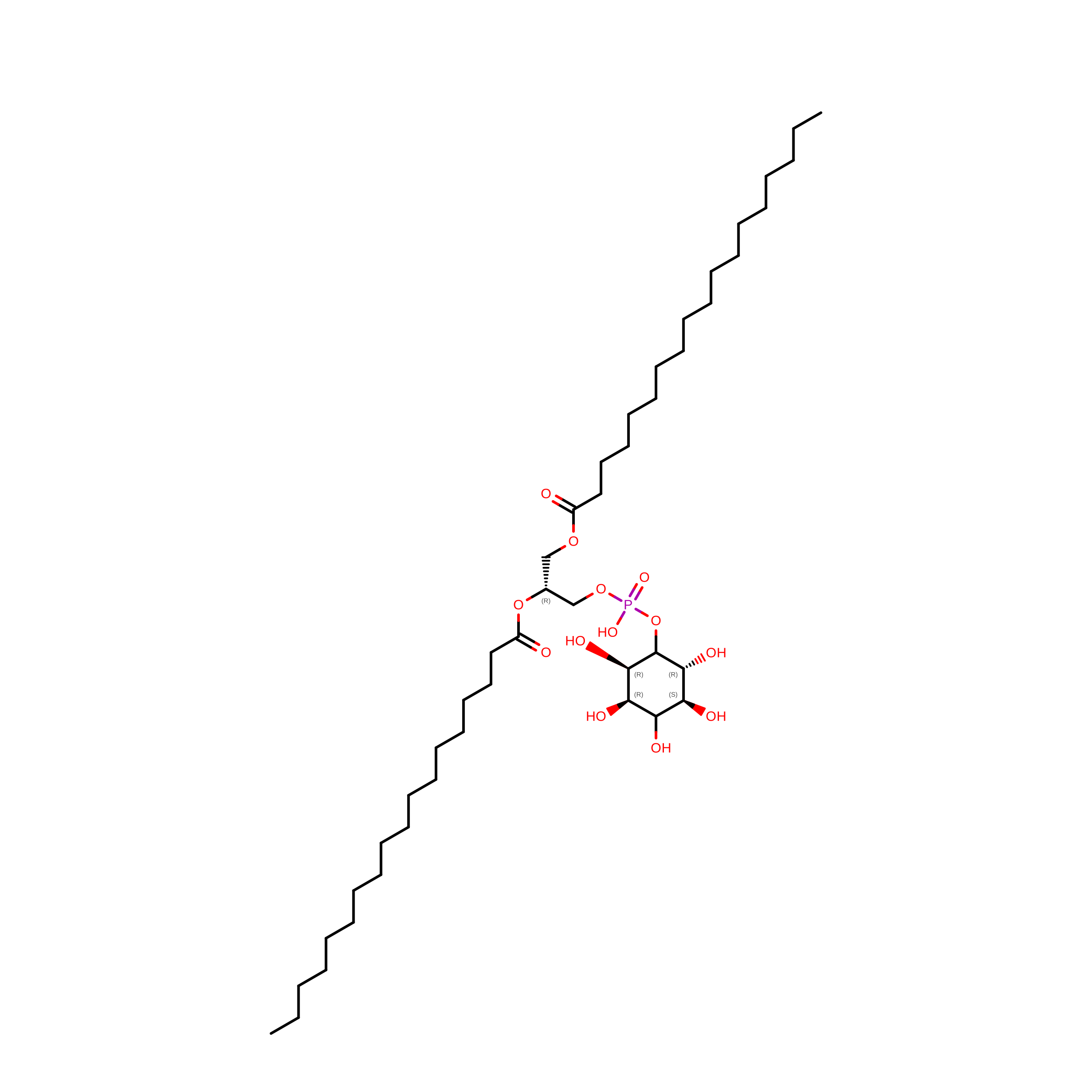
8IJ

Query on 8IJ


Download:Ideal Coordinates CCD File
CA [auth C],
F [auth A],
MA [auth D],
S [auth B]
(2R)-3-{[(R)-hydroxy{[(1S,2R,3R,4S,5S,6R)-2,3,4,5,6-pentahydroxycyclohexyl]oxy}phosphoryl]oxy}propane-1,2-diyl dioctadecanoate
C45 H87 O13 P
FQZQXPXKJFOAGE-KQKURGKFSA-N
POV

Query on POV


Download:Ideal Coordinates CCD File
AA [auth C]
BA [auth C]
DA [auth C]
E [auth A]
EA [auth C]
AA [auth C],
BA [auth C],
DA [auth C],
E [auth A],
EA [auth C],
G [auth A],
GA [auth C],
H [auth A],
HA [auth C],
IA [auth C],
J [auth A],
JA [auth C],
K [auth A],
KA [auth D],
L [auth A],
LA [auth D],
M [auth A],
N [auth A],
NA [auth D],
OA [auth D],
P [auth B],
Q [auth B],
QA [auth D],
R [auth B],
RA [auth D],
SA [auth D],
T [auth B],
U [auth B],
W [auth B],
X [auth B],
Y [auth B],
Z [auth B]
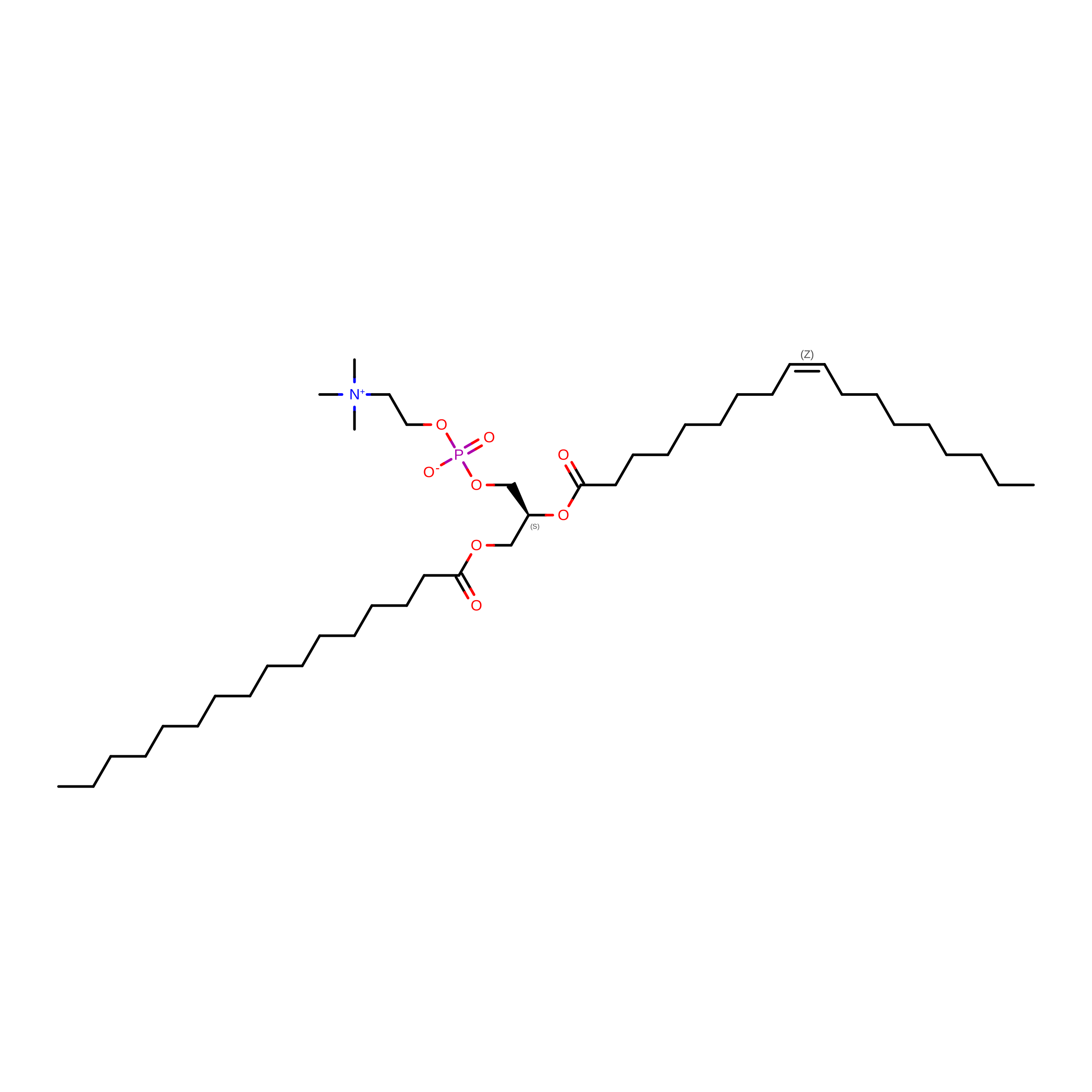
(2S)-3-(hexadecanoyloxy)-2-[(9Z)-octadec-9-enoyloxy]propyl 2-(trimethylammonio)ethyl phosphate
C42 H82 N O8 P
WTJKGGKOPKCXLL-PFDVCBLKSA-N
TRD

Query on TRD


Download:Ideal Coordinates CCD File
FA [auth C],
I [auth A],
PA [auth D],
V [auth B]
TRIDECANE
C13 H28
IIYFAKIEWZDVMP-UHFFFAOYSA-N
NA

Query on NA


Download:Ideal Coordinates CCD File
O [auth A],
TA [auth D]
SODIUM ION
Na
FKNQFGJONOIPTF-UHFFFAOYSA-N

Experimental Data & Validation

Experimental Data

  • Method: ELECTRON MICROSCOPY
  • Resolution: 2.74 Å
  • Aggregation State: PARTICLE 
  • Reconstruction Method: SINGLE PARTICLE 
EM Software:
TaskSoftware PackageVersion
RECONSTRUCTIONcryoSPARCv4.4
MODEL REFINEMENTPHENIX1.11.1_2575

Structure Validation

View Full Validation Report


Entry History 

& Funding Information

Deposition Data


Funding OrganizationLocationGrant Number
National Institutes of Health/National Cancer Institute (NIH/NCI)United StatesR01 CA206573
National Institutes of Health/National Institute of Arthritis and Musculoskeletal and Skin Diseases (NIH/NIAMS)United StatesR01 AR078814
National Institutes of Health/National Institute of Neurological Disorders and Stroke (NIH/NINDS)United StatesR01 NS107253
National Institutes of Health/National Institute of Neurological Disorders and Stroke (NIH/NINDS)United StatesR37 NS083660

Revision History  (Full details and data files)

  • Version 1.0: 2025-07-23
    Type: Initial release
  • Version 1.1: 2025-07-30
    Changes: Data collection, Database references