Download Mendeley
Discovery and Characterization of Diverse Non-nucleotide Inhibitors of DNPH1 Using an Integrated Hit Finding Strategy.
Whitehurst, B.C., Anderson, N.A., Argyrou, A., Astles, P., Barlaam, B., Cadogan, E.B., Carlino, L., Collie, G.W., Edwards, A., Kitching, L., Li, Y., Milbradt, A.G., Nikkila, J., Northall, S., Pahlen, S., Patel, S., Savory, W., Schade, M., Spencer, J.A., Stead, D., Stubbs, C.J., Wang, A., Wang, W.(2026) ACS Med Chem Lett 17: 226-234
- PubMed: 41531952
- DOI: https://doi.org/10.1021/acsmedchemlett.5c00651
- Primary Citation Related Structures:
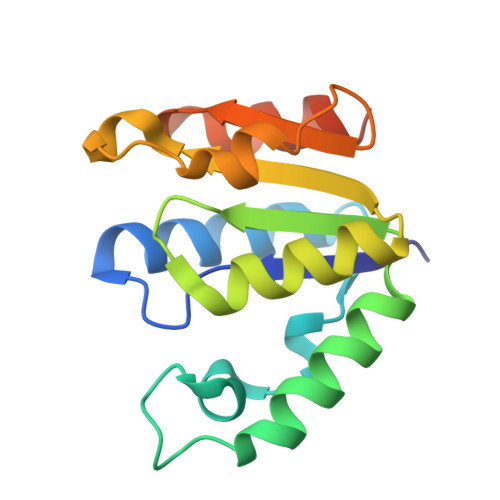
9RPO, 9S0O, 9S1N, 9S1O - PubMed Abstract:
DNPH1 is a hydrolase enzyme that degrades the noncanonical nucleotide 5-hydroxymethyl-2'-deoxyuridine 5'-monophosphate (hmdUMP), thus acting as a nucleotide pool sanitizer by preventing its aberrant incorporation into DNA. Recent studies have shown that loss of DNPH1 enhances the sensitivity of homologous recombination repair-deficient cancer cells to PARP inhibitors, highlighting its potential as an attractive therapeutic target. Herein we report the design and prosecution of an integrated hit finding strategy combining high-throughput screening, DNA-encoded library screening, and fragment-based lead generation which enabled the discovery of the first non-nucleotide ligands for DNPH1. We compare four hit compounds which differ markedly in their chemical structures, physicochemical properties, and binding modes and summarize parallel hit-to-lead workup efforts. We also provide discussion of the merits of an integrated approach for hit discovery when applied to challenging novel targets such as DNPH1.
- Hit Discovery, Discovery Sciences, R&D, AstraZeneca, Cambridge CB2 0AA, United Kingdom.
Organizational Affiliation: