9S7L | pdb_00009s7l

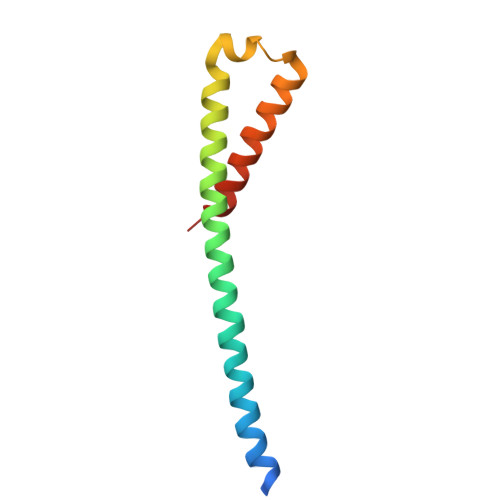
Structure of Centrosomin (Cnn) partial PReM domain 490-579aa of Drosophila melanogaster- S567A S571A mutant


Experimental Data Snapshot

  • Method: X-RAY DIFFRACTION
  • Resolution: 2.00 Å
  • R-Value Free: 
    0.272 (Depositor), 0.272 (DCC) 
  • R-Value Work: 
    0.229 (Depositor), 0.227 (DCC) 
  • R-Value Observed: 
    0.231 (Depositor) 

Starting Model: experimental
View more details

wwPDB Validation 3D Report Full Report

Validation slider image for 9S7L

This is version 1.1 of the entry. See complete history

Literature

Polo/PLK1 phosphorylation relieves Centrosomin/Cnn autoinhibition to promote centrosome scaffold assembly.

Mohamad, N.Wong, S.S.Majumdar, A.Wainman, A.Holland-Kaye, I.Hubatsch, L.Novak, Z.Pozniakovsky, A.Ruer-Gruss, M.Haensele, A.F.M.Caballe, A.Johnson, S.Lea, S.M.Hyman, A.A.Raff, J.W.

(2026) EMBO J 

  • DOI: https://doi.org/10.1038/s44318-026-00878-x
  • Primary Citation Related Structures: 
    9S7L, 9T4T

  • PubMed Abstract: 

    Mitotic centrosome maturation requires Polo/PLK1-dependent expansion of the pericentriolar material (PCM). In Drosophila, Centrosomin (Cnn) assembles a scaffold around mitotic centrioles through interactions between its PReM and CM2 domains. Here, we show that PReM adopts an autoinhibited helical hairpin conformation that prevents CM2 binding. Polo/PLK1 phosphorylation relieves this autoinhibition, enabling scaffold assembly, whereas phospho-blocking mutations disrupt PReM-CM2 binding in vitro and Cnn scaffold assembly in vivo. Potential functionally analogous domains have been identified in the human and C. elegans Cnn homologues CDK5RAP2 and SPD-5. We find that the human protein appears to share a structurally similar mechanism for scaffold assembly, but the worm protein does not. Consistent with this, deletion of these domains alters the dynamics of Cnn condensates in vitro, but has little effect on SPD-5 condensate dynamics. We conclude that Polo/PLK1 promotes mitotic centrosome assembly, at least in part, by relieving autoinhibitory intramolecular interactions.


  • Organizational Affiliation
    • Sir William Dunn School of Pathology, University of Oxford, Oxford, UK.

Macromolecule Content 

  • Total Structure Weight: 21.37 kDa 
  • Atom Count: 1,333 
  • Modeled Residue Count: 164 
  • Deposited Residue Count: 186 
  • Unique protein chains: 1

Macromolecules

Find similar proteins by:|  3D Structure
Entity ID: 1
MoleculeChains  Sequence LengthOrganismDetailsImage
Centrosomin
A, B
93Drosophila melanogasterMutation(s): 2 
Gene Names: cnnArrCG4832
UniProt
Find proteins for P54623 (Drosophila melanogaster)
Explore P54623 
Go to UniProtKB:  P54623
Entity Groups
Sequence Clusters30% Identity50% Identity70% Identity90% Identity95% Identity100% Identity
UniProt GroupP54623
Sequence Annotations
Expand
Reference Sequence

Experimental Data & Validation

Experimental Data

  • Method: X-RAY DIFFRACTION
  • Resolution: 2.00 Å
  • R-Value Free:  0.272 (Depositor), 0.272 (DCC) 
  • R-Value Work:  0.229 (Depositor), 0.227 (DCC) 
  • R-Value Observed: 0.231 (Depositor) 
Space Group: P 61
Unit Cell:
Length ( Å )Angle ( ˚ )
a = 59.45α = 90
b = 59.45β = 90
c = 107.69γ = 120
Software Package:
Software NamePurpose
PHENIXrefinement
xia2data reduction
Aimlessdata scaling
PHASERphasing

Structure Validation

View Full Validation Report


Entry History 

& Funding Information

Deposition Data


Funding OrganizationLocationGrant Number
Wellcome TrustUnited Kingdom215523; 209194

Revision History  (Full details and data files)

  • Version 1.0: 2026-08-19
    Type: Initial release
  • Version 1.1: 2026-09-09
    Changes: Database references