Download Mendeley
Mechanistic study of PDE5A inhibitors from the prepared folium of Epimedium sagittatum maxim.
Fang, Y., Wu, S., Xu, J., Chen, J., Shi, W., Wang, H., Li, S., Xie, H., Tao, H., Pan, L., Zang, Y., Yao, G., Zheng, X.(2026) J Struct Biol 218: 108279-108279
- PubMed: 41380862 Search on PubMed
- DOI: https://doi.org/10.1016/j.jsb.2025.108279
- Primary Citation Related Structures:
9XC4, 9XC5 - PubMed Abstract:
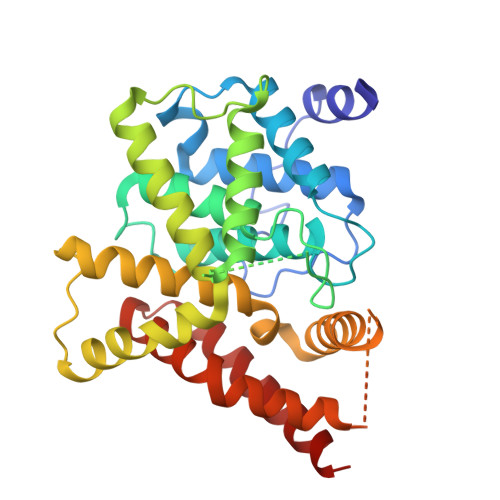
Phosphodiesterase-5 (PDE5A) is a critical therapeutic target for treating male erectile dysfunction (ED). PDE5A inhibitors like sildenafil are clinically effective, but exhibit side effects due to non-specific inhibition of related PDE isoforms. This necessitates the discovery of safer and specific PDE5A inhibitors. The prepared folium of Epimedium sagittatum (PFES) is a primary sovereign drug in traditional Chinese medicine (TCM) formulations for ED. As part of ongoing research into its pharmacodynamic basis, this study isolated and identified forty-four flavonoids and organic acids from PFES. The inhibitory activities of these compounds against PDE5A were systematically evaluated, and three compounds (1, 5, and 6) are demonstrated to have significant PDE5A inhibition activities. Notably, the compound 6 (baohuoside I), was previously confirmed the activitywith PDE5A, and its co-crystal structure with PDE5A was also reported. To elucidate the molecular mechanisms underlying the inhibition of PDE5A by compound 1 and 5, we solved the crystal structures of the catalytic domain of PDE5A in complex with compound 1 and 5. Further structural analyses revealed distinct binding modes adopted by 1 and 5 for occupying the PDE5A active site, highlighting their specific interactions with PDE5A compared to each other and to other established inhibitors like sildenafil. In summary, these findings underscore the potential of PFES-derived natural compounds as specific PDE5A inhibitors, and provide crucial insights for the rational development of novel ED therapeutics with potentially improved specificity and reduced side effects based on TCM constituents.
- State Key Laboratory of Discovery and Utilization of Functional Components in Traditional Chinese Medicine, Innovation Research Institute of Traditional Chinese Medicine, Shanghai University of Traditional Chinese Medicine, 1200 Cailun Road, Shanghai 201203, PR China.
Organizational Affiliation: