6OW0 | pdb_00006ow0

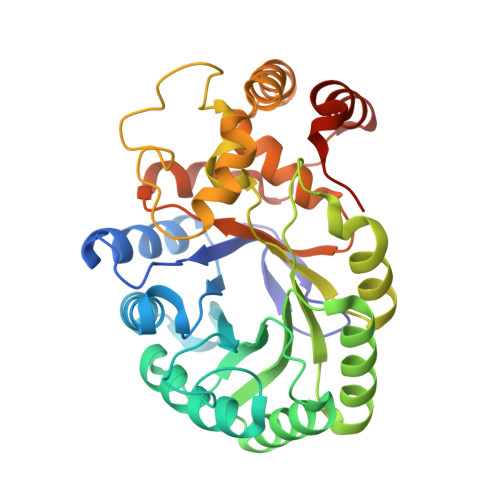
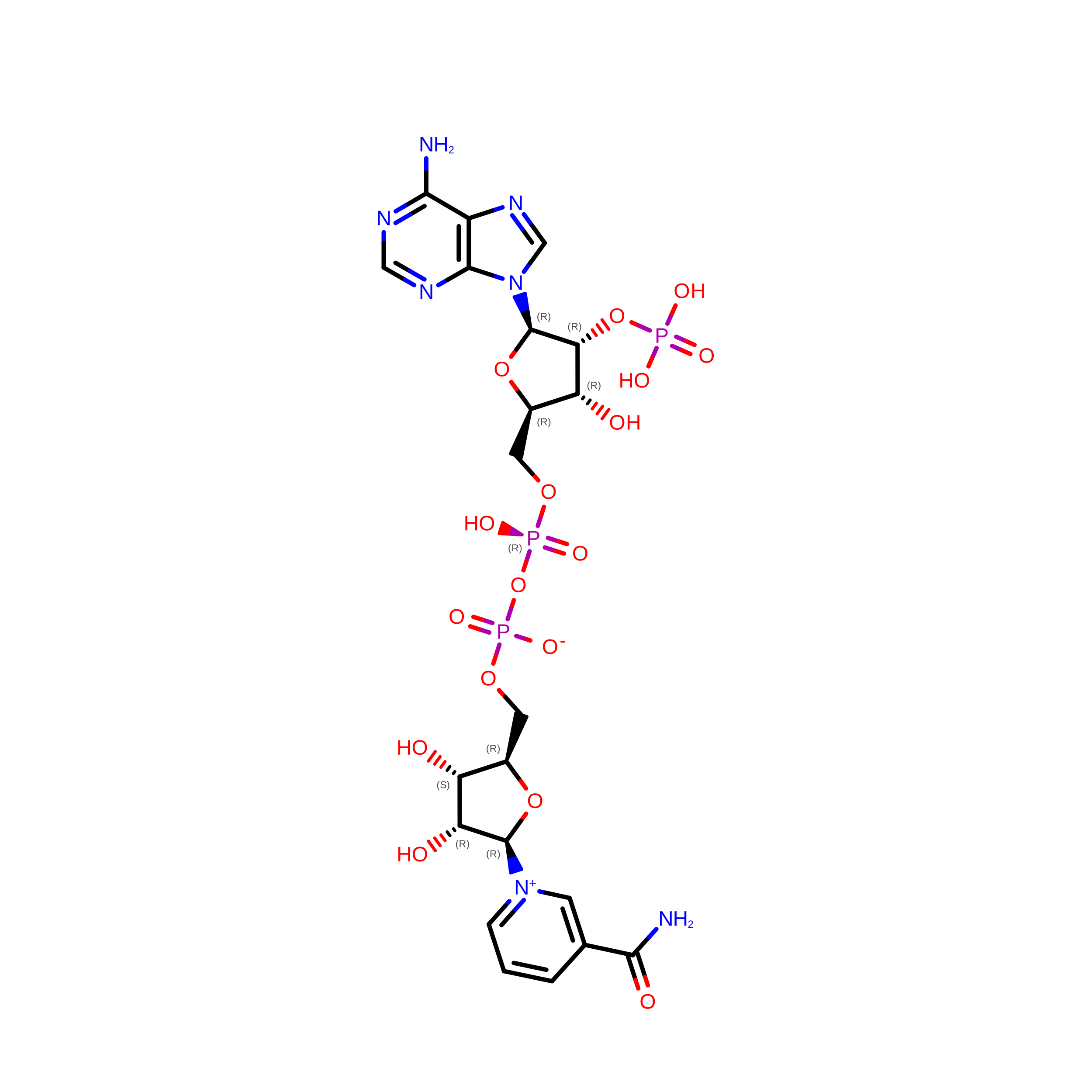
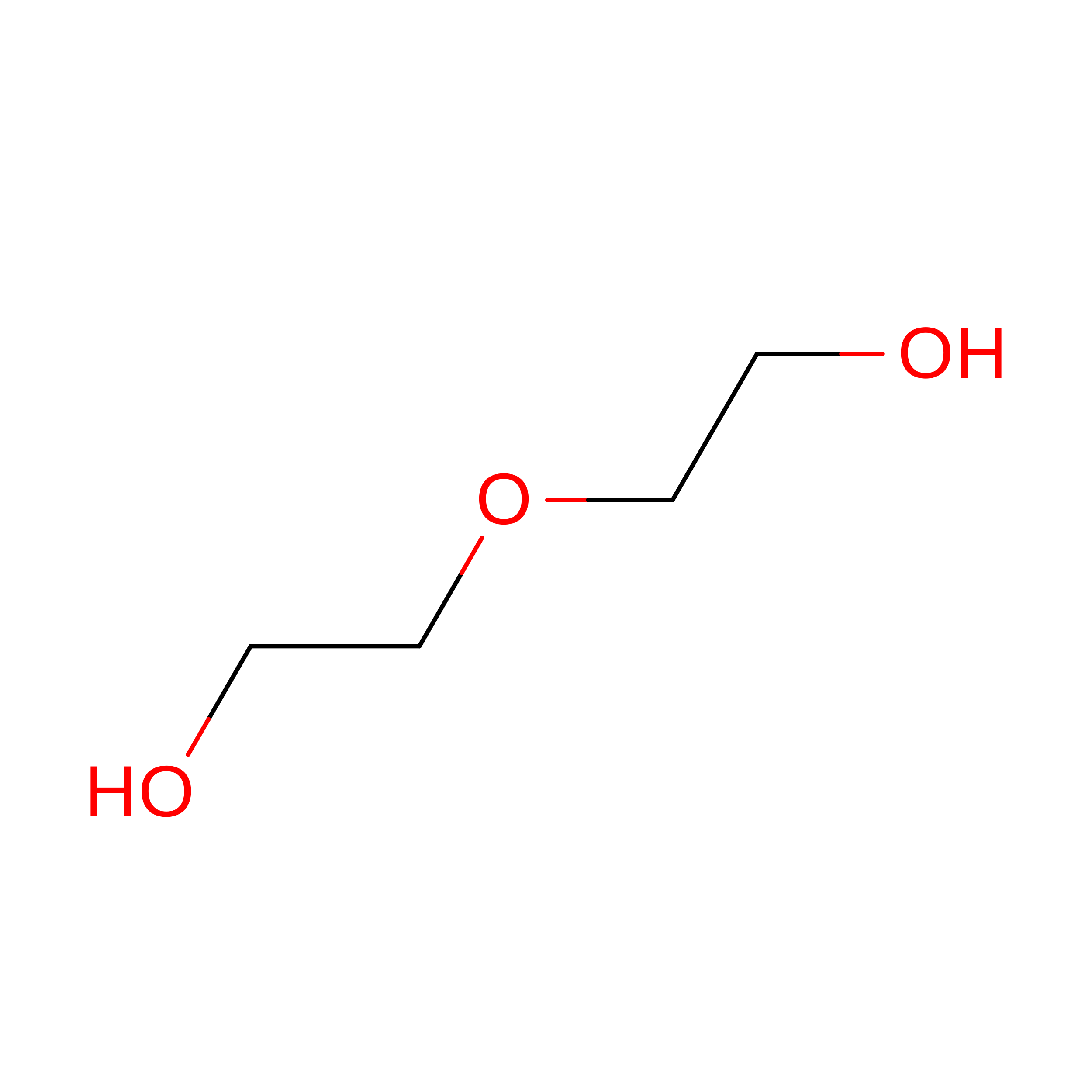
Crystal structure of mithramycin 3-side chain keto-reductase MtmW in complex with NAD+ and PEG


Experimental Data Snapshot

  • Method: X-RAY DIFFRACTION
  • Resolution: 2.67 Å
  • R-Value Free: 
    0.228 (Depositor), 0.226 (DCC) 
  • R-Value Work: 
    0.181 (Depositor), 0.186 (DCC) 
  • R-Value Observed: 
    0.183 (Depositor) 

Starting Model: experimental
View more details

wwPDB Validation 3D Report Full Report

Validation slider image for 6OW0

Ligand Structure Quality Assessment 


This is version 1.2 of the entry. See complete history

Literature

Discovery of a Cryptic Intermediate in Late Steps of Mithramycin Biosynthesis.

Wheeler, R.Yu, X.Hou, C.Mitra, P.Chen, J.M.Herkules, F.Ivanov, D.N.Tsodikov, O.V.Rohr, J.

(2020) Angew Chem Int Ed Engl 59: 826-832

  • DOI: https://doi.org/10.1002/anie.201910241
  • Primary Citation Related Structures: 
    6OVQ, 6OVX, 6OW0

  • PubMed Abstract: 

    MtmOIV and MtmW catalyze the final two reactions in the mithramycin (MTM) biosynthetic pathway, the Baeyer-Villiger opening of the fourth ring of premithramycin B (PMB), creating the C3 pentyl side chain, strictly followed by reduction of the distal keto group on the new side chain. Unexpectedly this results in a C2 stereoisomer of mithramycin, iso-mithramycin (iso-MTM). Iso-MTM undergoes a non-enzymatic isomerization to MTM catalyzed by Mg 2+ ions. Crystal structures of MtmW and its complexes with co-substrate NADPH and PEG, suggest a catalytic mechanism of MtmW. The structures also show that a tetrameric assembly of this enzyme strikingly resembles the ring-shaped β subunit of a vertebrate ion channel. We show that MtmW and MtmOIV form a complex in the presence of PMB and NADPH, presumably to hand over the unstable MtmOIV product to MtmW, yielding iso-MTM, as a potential self-resistance mechanism against MTM toxicity.


  • Organizational Affiliation
    • Department of Pharmaceutical Sciences, College of Pharmacy, University of Kentucky, 789 South Limestone Street, Lexington, KY, 40536-0596, USA.

Macromolecule Content 

  • Total Structure Weight: 74.45 kDa 
  • Atom Count: 4,976 
  • Modeled Residue Count: 624 
  • Deposited Residue Count: 666 
  • Unique protein chains: 1

Macromolecules

Find similar proteins by:|  3D Structure
Entity ID: 1
MoleculeChains  Sequence LengthOrganismDetailsImage
MtmW
A, B
333Streptomyces argillaceusMutation(s): 0 
UniProt
Find proteins for Q194Q1 (Streptomyces argillaceus)
Explore Q194Q1 
Go to UniProtKB:  Q194Q1
Entity Groups
Sequence Clusters30% Identity50% Identity70% Identity90% Identity95% Identity100% Identity
UniProt GroupQ194Q1
Sequence Annotations
Expand
Reference Sequence

Experimental Data & Validation

Experimental Data

  • Method: X-RAY DIFFRACTION
  • Resolution: 2.67 Å
  • R-Value Free:  0.228 (Depositor), 0.226 (DCC) 
  • R-Value Work:  0.181 (Depositor), 0.186 (DCC) 
  • R-Value Observed: 0.183 (Depositor) 
Space Group: P 4 2 2
Unit Cell:
Length ( Å )Angle ( ˚ )
a = 124.679α = 90
b = 124.679β = 90
c = 107.359γ = 90
Software Package:
Software NamePurpose
REFMACrefinement
HKL-2000data reduction
HKL-2000data scaling
PHASERphasing

Structure Validation

View Full Validation Report


Ligand Structure Quality Assessment 


Entry History 

& Funding Information

Deposition Data


Funding OrganizationLocationGrant Number
National Institutes of Health/National Institute of General Medical Sciences (NIH/NIGMS)United StatesR01GM105977-01A1

Revision History  (Full details and data files)

  • Version 1.0: 2019-11-27
    Type: Initial release
  • Version 1.1: 2020-01-15
    Changes: Database references
  • Version 1.2: 2023-10-11
    Changes: Data collection, Database references, Refinement description