6Q7O | pdb_00006q7o

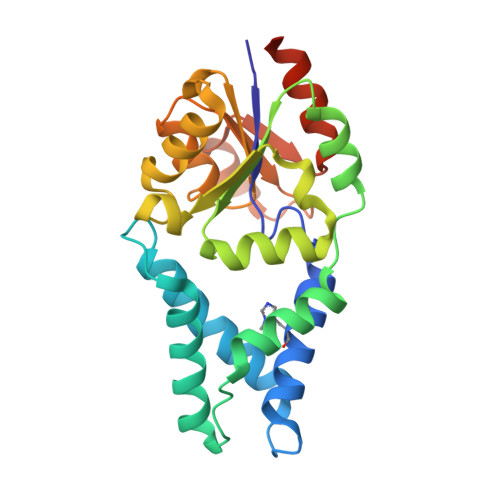
Crystal structure of OE1

  • Classification: HYDROLASE
  • Organism(s): Pyrococcus horikoshii
  • Expression System: Escherichia coli
  • Mutation(s): No 

  • Deposited: 2018-12-13 Released: 2019-06-05 
  • Deposition Author(s): Levy, C.W.
  • Funding Organization(s): Biotechnology and Biological Sciences Research Council, European Research Council

Experimental Data Snapshot

  • Method: X-RAY DIFFRACTION
  • Resolution: 2.00 Å
  • R-Value Free: 
    0.228 (Depositor), 0.230 (DCC) 
  • R-Value Work: 
    0.192 (Depositor), 0.193 (DCC) 
  • R-Value Observed: 
    0.194 (Depositor) 

Starting Model: experimental
View more details

wwPDB Validation 3D Report Full Report

Validation slider image for 6Q7O

This is version 1.2 of the entry. See complete history

Literature

Design and evolution of an enzyme with a non-canonical organocatalytic mechanism.

Burke, A.J.Lovelock, S.L.Frese, A.Crawshaw, R.Ortmayer, M.Dunstan, M.Levy, C.Green, A.P.

(2019) Nature 570: 219-223

  • DOI: https://doi.org/10.1038/s41586-019-1262-8
  • Primary Citation Related Structures: 
    6Q7N, 6Q7O, 6Q7P, 6Q7Q, 6Q7R

  • PubMed Abstract: 

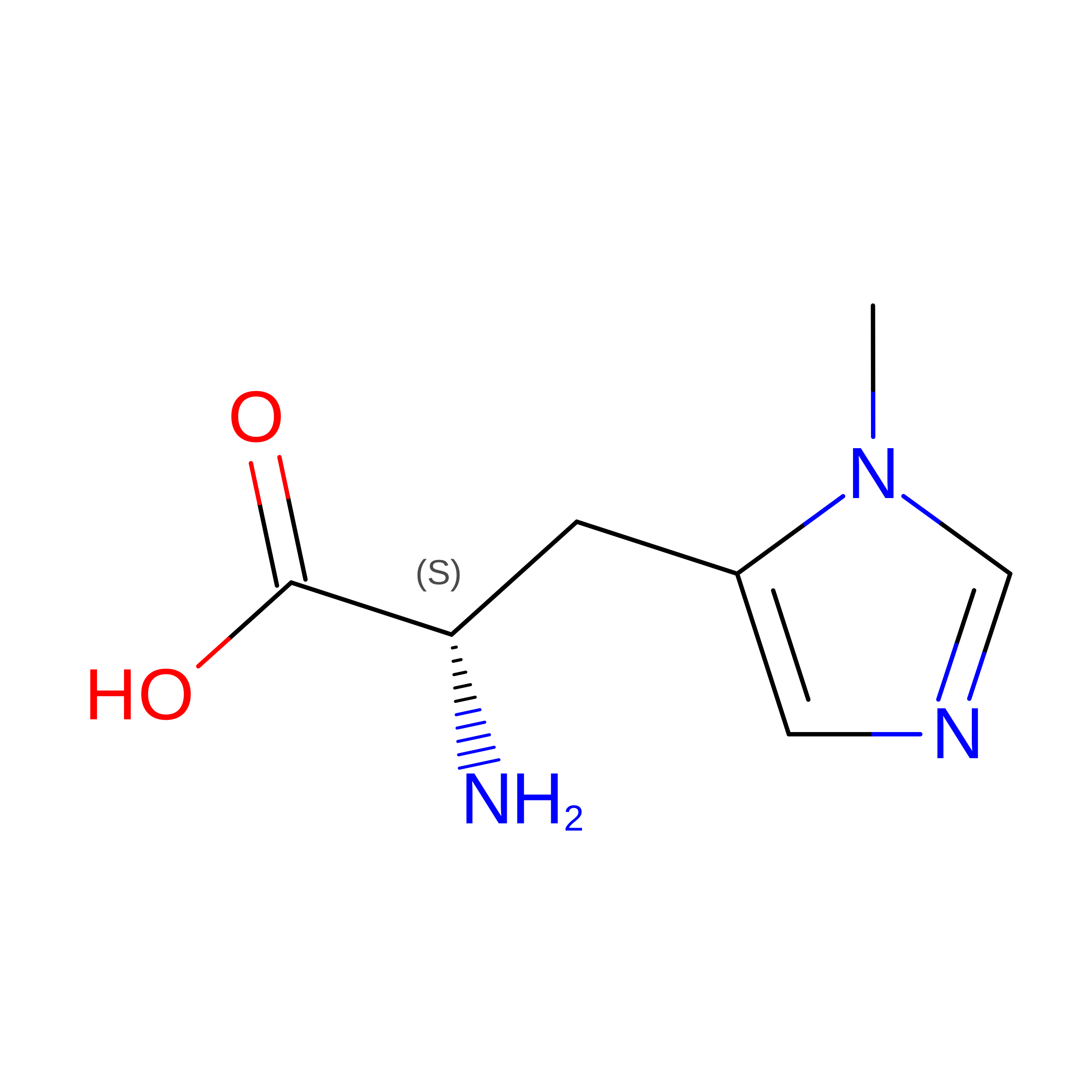
    The combination of computational design and laboratory evolution is a powerful and potentially versatile strategy for the development of enzymes with new functions 1-4 . However, the limited functionality presented by the genetic code restricts the range of catalytic mechanisms that are accessible in designed active sites. Inspired by mechanistic strategies from small-molecule organocatalysis 5 , here we report the generation of a hydrolytic enzyme that uses N δ -methylhistidine as a non-canonical catalytic nucleophile. Histidine methylation is essential for catalytic function because it prevents the formation of unreactive acyl-enzyme intermediates, which has been a long-standing challenge when using canonical nucleophiles in enzyme design 6-10 . Enzyme performance was optimized using directed evolution protocols adapted to an expanded genetic code, affording a biocatalyst capable of accelerating ester hydrolysis with greater than 9,000-fold increased efficiency over free N δ -methylhistidine in solution. Crystallographic snapshots along the evolutionary trajectory highlight the catalytic devices that are responsible for this increase in efficiency. N δ -methylhistidine can be considered to be a genetically encodable surrogate of the widely employed nucleophilic catalyst dimethylaminopyridine 11 , and its use will create opportunities to design and engineer enzymes for a wealth of valuable chemical transformations.


  • Organizational Affiliation
    • Manchester Institute of Biotechnology, School of Chemistry, University of Manchester, Manchester, UK.

Macromolecule Content 

  • Total Structure Weight: 27.73 kDa 
  • Atom Count: 2,062 
  • Modeled Residue Count: 230 
  • Deposited Residue Count: 242 
  • Unique protein chains: 1

Macromolecules

Find similar proteins by:|  3D Structure
Entity ID: 1
MoleculeChains  Sequence LengthOrganismDetailsImage
OE1242Pyrococcus horikoshiiMutation(s): 0 
Gene Names: PH0459
UniProt
Find proteins for O58216 (Pyrococcus horikoshii (strain ATCC 700860 / DSM 12428 / JCM 9974 / NBRC 100139 / OT-3))
Explore O58216 
Go to UniProtKB:  O58216
Entity Groups
Sequence Clusters30% Identity50% Identity70% Identity90% Identity95% Identity100% Identity
UniProt GroupO58216
Sequence Annotations
Expand
Reference Sequence

Small Molecules

Ligands 1 Unique
IDChains Name / Formula / InChI Key2D Diagram3D Interactions
CA

Query on CA


Download:Ideal Coordinates CCD File
B [auth A]CALCIUM ION
Ca
BHPQYMZQTOCNFJ-UHFFFAOYSA-N
Modified Residues  1 Unique
IDChains TypeFormula2D DiagramParent
MHS
Query on MHS
A
L-PEPTIDE LINKINGC7 H11 N3 O2HIS

Experimental Data & Validation

Experimental Data

  • Method: X-RAY DIFFRACTION
  • Resolution: 2.00 Å
  • R-Value Free:  0.228 (Depositor), 0.230 (DCC) 
  • R-Value Work:  0.192 (Depositor), 0.193 (DCC) 
  • R-Value Observed: 0.194 (Depositor) 
Space Group: P 1 21 1
Unit Cell:
Length ( Å )Angle ( ˚ )
a = 34.11α = 90
b = 70.53β = 104.24
c = 52.82γ = 90
Software Package:
Software NamePurpose
PHENIXrefinement
xia2data reduction
xia2data scaling
PHASERphasing

Structure Validation

View Full Validation Report


Entry History 

& Funding Information

Deposition Data

  • Released Date: 2019-06-05 
  • Deposition Author(s): Levy, C.W.

Funding OrganizationLocationGrant Number
Biotechnology and Biological Sciences Research CouncilUnited KingdomBB/M027023/1
European Research CouncilUnited Kingdom757991

Revision History  (Full details and data files)

  • Version 1.0: 2019-06-05
    Type: Initial release
  • Version 1.1: 2019-06-26
    Changes: Data collection, Database references
  • Version 1.2: 2024-01-24
    Changes: Data collection, Database references, Derived calculations, Refinement description